Get Full Government Meeting Transcripts, Videos, & Alerts Forever!
Get email alerts on the Property Taxes topic
No spam. Unsubscribe anytime.
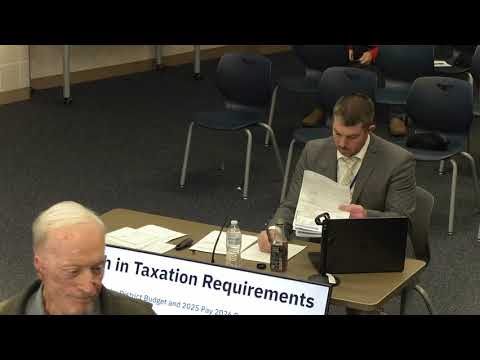
Albert Lea board approves 6.78% levy increase after Truth in Taxation hearing
Summary
After a Truth in Taxation hearing and public comment, the Albert Lea Area Schools Board approved a $10.46 million 2025-pay-2026 levy (up $664,110, or 6.78%), with district officials saying state funding formulas and declining enrollment are shifting the tax burden to local property owners.
The Albert Lea Area Schools Board of Education voted to approve the district’s 2025-pay-2026 levy on a 6.78% increase, approving a total proposed levy of $10,461,564 at its regular meeting following a Truth in Taxation hearing.
During the pre-meeting hearing, resident and farmer Marlo Logan pressed the board on why neighboring New Richland appeared to levy far less per acre for equivalent parcels, asking, “What do I get for that two-thirds more per acre?” The board responded that staff would examine individual tax statements and that staff had added a comparison slide to the presentation to illustrate differences between districts.
Presenter and district finance staff said levies and related state aid are determined by state statute and complex formulas administered by the Minnesota Department of Education. The presenter noted school levies are not sole sources of local revenue and explained the timing: the district certifies the levy in 2025, taxes are payable in 2026, and the revenue is recognized in the 2026–27 school year. He added, “We are not increasing a levy to increase our revenues,” and stressed that an increased levy can coincide with decreased state aid because aid tied to levies is driven by equalization formulas.
Board discussion acknowledged two competing pressures: limits on state funding and the district’s declining enrollment, which reduces state aid and pushes more of the funding burden onto local taxpayers. Board members said the district has already made multi-year reductions (roughly $2 million in prior cuts) and warned that approving a lower levy could force deeper staffing and program cuts. One board member noted the district has avoided asking voters for an operating referendum in recent years to limit additional taxpayer burden.
The board moved into its regular session and approved the levy as presented. The presenter offered to meet individually with taxpayers who brought specific tax-statement concerns and pointed listeners to the county appraisal appeals process for valuation disputes.
Next procedural step: the levy was approved by the board and will be reflected on 2026 tax statements; residents with valuation questions were advised to consult the county appeals process or contact district finance staff for one-on-one reviews.