
Gaithersburg leaves record open after hours of testimony on Rio Washingtonian lakefront plan
Get AI-powered insights, summaries, and transcripts
Subscribe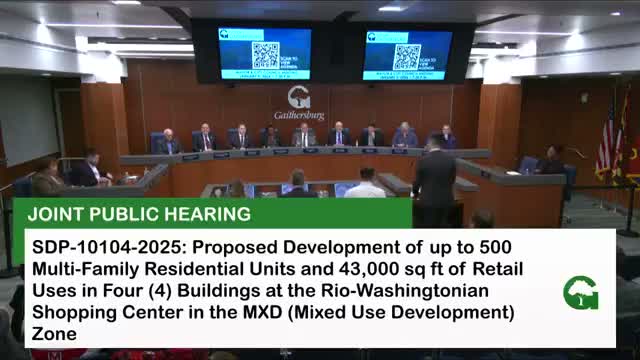
Summary
A joint public hearing on a schematic plan to add hundreds of apartments and retail at Rio Washingtonian prompted dozens of public speakers and detailed staff scrutiny; the planning commission and council voted to keep the record open to gather more information on traffic, tree variances and stormwater before a recommendation or decision.
The Gaithersburg Planning Commission and City Council on Jan. 5 heard more than three hours of testimony and questions about a schematic development plan (SDP) for the Rio Washingtonian Center, and both bodies voted unanimously to leave the public record open for more exhibits and comment.
Samuel Copeland, a city planning staffer, introduced SDP-10104-2025 for two Rio Washingtonian parcels and told the commission the plan would move the project into the schematic stage. Doug Smith, a project engineer in Public Works, described outstanding traffic-analysis items: staff approved a preliminary traffic impact study but said the final TIS must address interchange deficiencies at the Sammic Highway/Washingtonian Boulevard area and propose feasible mitigation that may require county approval.
Representatives of the property owner and developer, Jeff Perana and Heather Madison of the Peterson Companies, presented conceptual plans they said would add residential uses alongside retail. The presentation referenced an SDP-level figure of "up to 500" multifamily units and 43,000 square feet of retail; developer comments later described an overall development program of about 463 residential units and roughly 41,000 square feet of retail, with 72 moderately priced dwelling units (MPDUs) distributed across the project. The developer said parking would remain in surplus across the center (the presentation cited more than 2,700 parking spaces overall) and that residential parking would be dedicated and separated from retail parking.
Council members and commissioners focused their questions on circulation, emergency access, stormwater and tree preservation. Staff noted outstanding comments on stormwater management and sediment-erosion-control plans that must be resolved before a planning recommendation. The developer asked for a tree-variance to remove five trees (each described as in excess of 30 inches diameter) under city code 22-12; the applicant argued the trees impede feasible building footprints and said it met the four variance criteria.
Public turnout was substantial. Roughly a hundred written exhibits were already in the record and dozens of residents used three-minute slots to oppose the two lakeside apartment buildings proposed at Sites 2 and 3. Common concerns included loss of the existing green space, safety and congestion at the Grand Corner/Rio intersection (residents asked for weekend-peak analysis in addition to weekday AM/PM peaks), impacts to pedestrian experience and playground accessibility, and long-term environmental and health considerations for units near I‑270. Several speakers said they supported redevelopment at the Coles parcel but urged that lakeside open space be preserved.
Planning Commission Chair Bauer framed the commission's work as focused on integration — how new uses, roads and parking would connect to the existing retail and entertainment uses. Commissioners urged a closer look at phasing, circulation alternatives, and whether the lakeside buildings as drawn were feasible without significant adverse effects on the site's character.
Because of the volume of testimony and outstanding technical issues, the planning commission moved to keep its record open indefinitely; the motion carried unanimously. The City Council then adopted the same approach — voting to leave the record open so additional exhibits and focused analyses can be added to the hearing record before policy discussion and final action return to the council.
Next steps: the city will accept additional written testimony and technical exhibits (staff said the record would remain open to allow the applicant to address stormwater and erosion-control comments and other outstanding items). The city will notify the public when the planning commission forwards a recommendation to the council and when the item is scheduled for further action.