Dawsonville council approves rezoning for 120‑home subdivision with 22 conditions, ups per‑lot infrastructure fee
Loading...
Summary
The Dawsonville City Council approved rezoning of a 34.71‑acre parcel to a residential planned community for 120 single‑family/semi‑detached homes, requiring the developer to build a Maple Street extension, provide traffic improvements and pay $2,400 per lot toward road infrastructure and sidewalks.
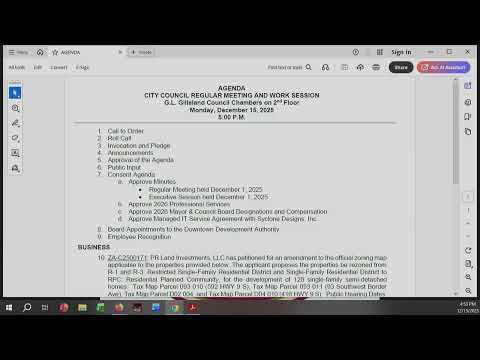
The Dawsonville City Council on Dec. 15 approved a rezoning and development agreement for a 34.71‑acre site to allow 120 single‑family and semi‑detached homes, attaching 22 conditions and changing one condition to require $2,400 per lot to fund road infrastructure and sidewalks.
Planner Dana Spade told council the application revises an earlier traffic study (Dec. 2) to account for school traffic and recommends left‑ and right‑turn lanes on Highway 9 at the proposed Maple Street extension. Spade said the parcel is split between the gateway corridor and a residential character area in Dawsonville’s 2023 comprehensive plan and that the residential portion does not meet the plan’s 0.2 units‑per‑acre guidance, noting staff and the planning commission recommended denial.
In public comment, Michael Miller, who said he represents the applicant, described the developer’s offer to design the traffic circle shown in the downtown plan, dedicate right of way on its side of the road, construct the Maple Street extension at the developer’s expense and contribute land or funds for other nearby intersections. "We've completed that, and we're confident that this road can be constructed as designed," Miller said.
Councilmember Caleb Phillips moved to approve the rezoning with the 22 stipulations presented by staff and raised the per‑lot contribution in stipulation 22 from $2,000 to $2,400, specifying the funds may be used for road infrastructure and sidewalks; the motion was seconded by a councilmember identified in the transcript as Ilg. The city clerk called the vote; the transcript does not record a full roll‑call tally for this item. The council proceeded to the next item after the vote, and the chair treated the motion as carried.
Staff outlined several technical conditions that will be enforced if the rezoning and RPC (residential planned community) zoning are adopted, including compliance with the International Fire Code and Dawson County Fire Prevention Ordinance sections cited by staff for fire access, hydrant placement and suppression water supply. Staff also noted sidewalk requirements for any new public road and said the applicant will provide plans for a roundabout but not install it unless the city elects a dedication/earmark approach for that feature.
The approval departs from the planning commission recommendation of denial based on density and plan conformance; the council’s conditions emphasize infrastructure first, including the Maple Street extension and a higher per‑lot contribution for nearby transportation improvements.
Next steps: staff will incorporate the approved stipulations into the development agreement and record the revised condition language; the developer is to deliver the revised copy for the city attorney and clerk if the motion passed.