
Cheyenne committee recommends ordinance allowing administrative inspection warrants for fire and building officials
Get AI-powered insights, summaries, and transcripts
Subscribe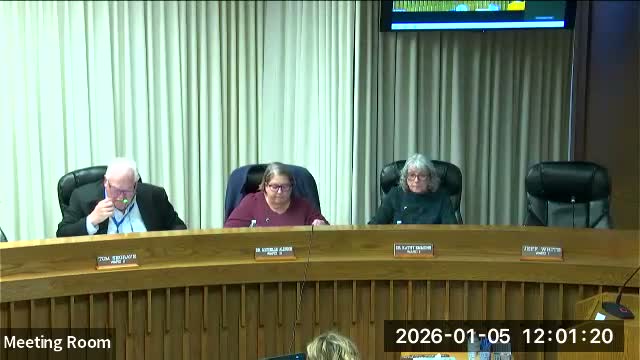
Summary
A City of Cheyenne committee voted to recommend approval of an ordinance that would add administrative inspection-warrant authority to the municipal code, enabling the fire chief and chief building official to seek warrants to inspect properties when consent cannot be obtained.
A City of Cheyenne committee voted to recommend approval of an ordinance (second reading) that would add Chapter 1.28 to the municipal code, authorizing administrative inspection warrants for the city’s fire chief and chief building official.
Deputy City Attorney David Hopkinson told the committee the ordinance "allows the chief of the fire department and the chief building official to seek administrative inspection warrants," describing the warrants as an administrative—rather than criminal—mechanism with a lower evidentiary standard to verify property conditions and enforce building- and safety-related municipal codes.
Hopkinson said the authority is intended for situations such as abandoned or red‑tagged properties where staff cannot locate or obtain consent from the owner but need to confirm whether a structure is unsafe. "This would be in place to allow [staff] to go to municipal court and say, hey, we've got this property...we can't locate the owner," he said.
Chief Dycheshorn of Cheyenne Fire Rescue told the committee the department generally seeks consent but sometimes lacks a non‑criminal tool to return after emergencies or to continue fire investigations. "This just gives our our folks a tool...gives them clear reason to be there," he said, adding that the department wants to avoid violating Fourth Amendment rights and expects an operational policy to govern use.
Hopkinson clarified the draft excludes routine nuisance enforcement—"things like, you know, if your grass is too long"—and is focused on matters tied to building code, permitting and safety. Committee members also discussed alternatives such as drones, with a committee speaker noting a recent state statute limits drone use and Hopkinson cautioning about constitutional limits on evidence-gathering.
On procedure, a committee member moved to approve the recommendation and another seconded. After a voice vote in which Councilman White said "Aye," the chair said, "The recommendation for Monday night will be to approve," indicating the committee will forward the ordinance to the City Council for final consideration.
The committee did not record a roll-call tally in the transcript; the action recorded in committee is a recommendation to the full council. The ordinance’s proponents said warrants would be used sparingly and only after attempts to obtain consent, while staff stressed they are intended as a safety and code‑enforcement tool rather than for minor nuisance matters.
The ordinance will be considered by the City Council at its next meeting on Monday night, according to the committee’s recommendation.