
Resident urges more judicial transparency in voters' pamphlet; auditor says state law limits county authority
Get AI-powered insights, summaries, and transcripts
Subscribe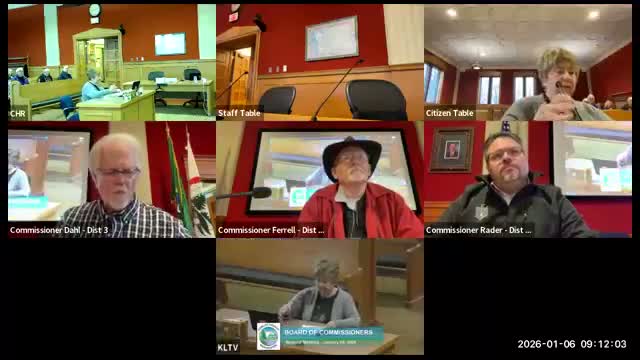
Summary
A Cowlitz County resident urged the commissioners to require more information about judges in the voters' pamphlet and criticized juvenile-justice outcomes; Auditor Elaine Miller Karas responded that state law governs pamphlet content for state-filed candidates, limiting the county's ability to compel additional material.
During public comment at the Cowlitz County Board of Commissioners' first regular meeting of 2026, a resident identified in the transcript as Flo criticized local judicial outcomes and urged changes to the county voters' pamphlet so voters could better evaluate judges.
Flo told commissioners she had "a lot of downtime" to think about the issue and said the county's judges "hold a lot of power" while the public has little information about how they rule. She said the juvenile facility typically has an average of "6 to 8" youths (with highs she described as "12"), and asserted the county spends "not quite 4,000,000, but 3 over 3 and a half million dollars a year" on the facility and is not getting sufficient benefit from that spending.
Auditor Elaine Miller Karas responded at the meeting that her office sets local rules for the voters' pamphlet but that state law determines what is included for state-level candidates such as most superior court judges. "Those rules are set in state law," Karas said, adding that the county can adopt rules only for local candidates; when candidates choose not to submit a statement or photo to the pamphlet "that's a candidate's choice." She encouraged members of the public to engage directly with elected officials and noted her office routinely reminds candidates of submission deadlines.
Board members and other commissioners acknowledged the complaint's political sensitivity and the limits of the board's authority over judicial decision-making, while noting the county is responsible for facility ownership and could explore alternatives for juvenile services (one commissioner suggested repurposing or building a different facility geared to mental-health treatment). Commissioners emphasized staying within the separate roles of elected branches while agreeing to consider facility planning and budgeting matters within their jurisdiction.
The exchange on the record documents citizen frustration with judicial transparency and juvenile-justice outcomes, the auditor's explanation of legal limits on county control over the voters' pamphlet for state-filed offices, and commissioners' acknowledgment that while they cannot direct judicial decisions they do control facility ownership and budgeting.