Elkhart County commissioners repeal Goshen Dam Pond EID after residents urge conservation over herbicides
Loading...
Summary
After a public hearing in which property owners urged using remaining EID funds for upstream conservation rather than aquatic herbicides, the Elkhart County Board of Commissioners voted unanimously to repeal the Goshen Dam Pond Economic Improvement District and defer decisions on distributing the remaining funds.
Elkhart County commissioners voted unanimously Jan. 5 to repeal the ordinance establishing the Goshen Dam Pond Economic Improvement District (EID), closing the door on further assessments and deferring a decision on how to distribute the district’s remaining funds.
County Attorney Steve Olson presented Commissioner Ordinance CO-2026-01, which would repeal Ordinance 2014-403 and terminate the Goshen Dam Pond EID under Indiana Code § 36-7-22-9. Olson said the EID was established in October 2014, an interlocal agreement with the City of Goshen was later terminated, and the board had already stopped new assessments beginning in 2023. The repeal, Olson said, would dissolve the EID board and leave asset distribution to the county commissioners to decide at a later public meeting.
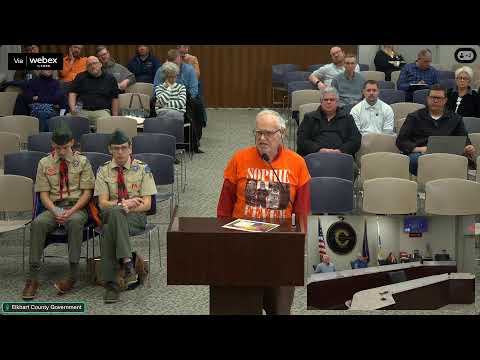
The board opened a public hearing. Dozens of residents who live on or near Goshen Dam Pond urged the commissioners to direct remaining EID funds toward long-term conservation measures rather than short-term chemical treatments. Stuart Mead, who said he has lived on Goshen Pond for 35 years and is a former Elkhart River Restoration Association (ERRA) board member, urged the money be used for soil and water conservation district (SWCD) practices, such as buffer strips and no-till farming, to reduce sediment and pollutant runoff. “Herbicides can kill plants that are beneficial to aquatic life,” Mead said, and he recommended channeling funds to conservation programs rather than spraying.
Several other speakers echoed that view. Jonathan Schramm, ERRA board president, said ERRA supports land conservation and shoreline restoration and that either ERRA or the SWCD could administer funds to target upstream subwatersheds. Nancy Brown, a former SWCD program manager and past ERRA president, said she preferred the SWCD manage the funds because of its capability to run upstream conservation programs. Several waterfront residents, including William Mateer, opposed tax dollars being used for herbicide applications and asked that remaining funds be refunded to those who paid in or be spent on upstream conservation that would address sedimentation.
At the close of the hearing, a commissioner moved to adopt the version of CO-2026-01 that repeals the EID and dissolves its board while leaving decisions about distributing assets to the commissioners at a later public meeting. The motion was seconded and carried unanimously. Commissioners and staff discussed but did not approve returning funds to individual payers, with one commissioner describing such a refund as a ‘‘logistics nightmare’’ that could cost the county more in administration. The board’s action ends the EID as of the meeting and preserves the public comment record to guide a later decision on how to allocate the remaining funds.
The public record at the meeting included differing statements about the exact dollar amount of the appropriation balance. At one point a figure of $139,006.41 was read aloud; at another point a staff speaker described the amount as $139,641 and referenced roughly $42,865 related to criminal justice earmarking in a separate fund request. Commissioners said no further assessments have been collected since 2023.
The next procedural step is for the commissioners to return to public session at a later date to identify the recipient(s) and specific eligible uses of remaining EID funds. County Attorney Olson said the repeal can be effective immediately while the board later follows statutory procedures when it brings forward the distribution plan at a public meeting.