Get Full Government Meeting Transcripts, Videos, & Alerts Forever!
Get email alerts on the Watershed Governance topic
No spam. Unsubscribe anytime.
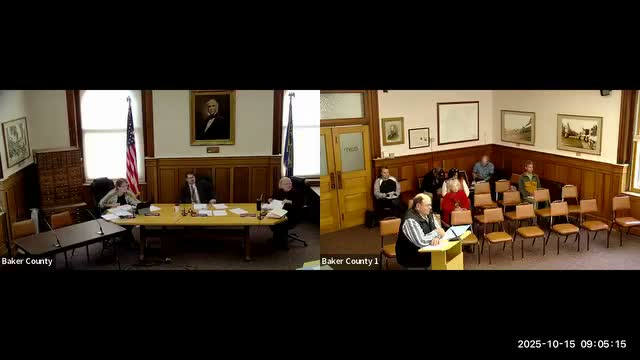
Baker County resident urges commissioners to assert oversight of Powder Basin Watershed Council
Summary
Curtis Martin, a Baker County landowner, told commissioners the Powder Basin Watershed Council operates autonomously, lacks producer representation and has pursued projects without adequate local notice; he cited ORS statutes and urged county involvement ahead of the council’s meeting Friday.
Curtis Martin of North Powder told the Baker County Board of Commissioners during public comment that the Powder Basin Watershed Council (PBWC) has been operating with too little local oversight and asked the board to exercise the authority he said the county retains over watershed councils.
Martin cited state statute and administrative rules, saying the council was intended to be "a voluntary local organization designated by local government convened by a county governing body" and that the council "really needs oversight because I'm the only producer on this board." He said recent projects, including work on Trout Creek and a Camp Creek enhancement funded at about $230,000, proceeded without adequate communication with private landowners, grazing permittees and water-rights holders.
Commissioners and staff discussed the council’s nonprofit status and what that means for county oversight. One commissioner noted the council had broken away from the Soil and Water Conservation District and incorporated as a nonprofit, and staff said that nonprofits have different oversight and reporting requirements. Martin told the board he had found language in Oregon Administrative Rules and ORS he believed required a balanced, representative board and that PBWC’s membership did not meet that standard.
Martin also said the council and partner agencies had placed beaver analogs and other structures that flooded grazing areas on Trout Creek, and he cited a private landowner’s report that 15 analogs had been removed following complaints. He said the Baker County Livestock Association circulated notices in support of scrutiny and that several residents plan to attend PBWC’s meeting at OTEC on Friday.
County staff and commissioners said they would review the bylaws and the ORS/OAR citations Martin provided and try to obtain the council’s bylaws for review. Commissioners clarified that some funding oversight rests with grantors (for example, OWEB) and that reporting tied to grant awards provides a level of accountability, but they also agreed to monitor the situation and requested copies of the council’s bylaws and any relevant grant documents.
The board did not take a formal action at the meeting; commissioners said they would follow up by requesting documents and watching the council’s public meeting and grant reporting.
Ending: Martin’s comments put PBWC oversight on the commissioners’ short-term agenda: staff will pursue the council bylaws and statutory references Martin cited and report back at a future meeting.