Get email alerts on the Rio Grande Water Supply topic
No spam. Unsubscribe anytime.
Rio Grande treaty shortfalls leave Valley facing multi‑year water deficit, keynote warns
Summary
At the Rio Grande Valley Utility Conference, Sonny Hinojosa said Mexico ended the most recent five‑year treaty cycle in arrears — roughly 865,000 acre‑feet — leaving U.S. storage at about 26.8% and agriculture facing significant shortages unless deliveries are made or other measures taken.
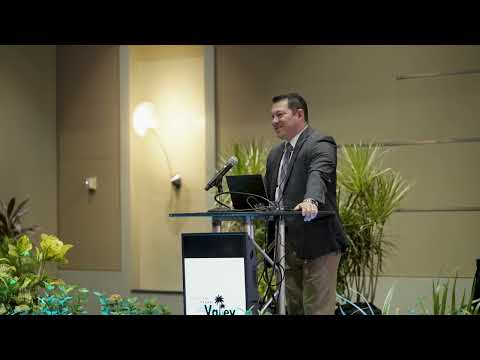
Sonny Hinojosa, a long‑time Rio Grande water manager and current Rio Grande Water Advocate, told attendees at the Rio Grande Valley Utility Conference in McAllen that the most recent five‑year treaty cycle with Mexico ended Oct. 24 with a significant delivery deficit that now becomes a debt for the new cycle.
Hinojosa summarized reservoir and treaty mechanics and the consequences for regional water users. He said the U.S. share of storage in the two international reservoirs is limited — ‘‘So we have 906,000 acre feet, which is a lot better than where we were, but still not enough water,’’ — and that Mexico ‘‘was in arrears when this cycle ended, 865,000 acre feet.’’ The keynote laid out the arithmetic that determines monthly allocations and the order in which reservoirs are drawn down, including dead storage, the domestic/municipal/industrial (DMI) reserve and operational reserves.
Why it matters: Hinojosa said agriculture bears the brunt of shortages because irrigated farming accounts for the largest portion of regional withdrawals (around 1,000,000 acre‑feet in a typical year) while municipal supplies are protected by the DMI reserve. That gap — combined with current storage levels of roughly 26.8% of conservation capacity — means the Valley has less than a one‑year snapshot of supply on hand in typical conditions.
Hinojosa described a recent procedural change at the International Boundary and Water Commission (IBWC): a Minute adopted and made usable in the current five‑year cycle that allows Mexico to assign parts of its two‑thirds share or transfer stored water (including inflows from the Rio San Juan and Rio Alamo) to the United States, a measure that helped relieve shortfalls earlier in the year. Hinojosa also explained that the treaty uses a five‑year averaging rule of 350,000 acre‑feet per year from certain Mexican tributaries and that deficiencies in one cycle carry forward as debt into the next.
On enforcement, Hinojosa answered an audience question by saying there is no direct penalty in the 1944 treaty for non‑delivery: "No, sir. Unfortunately, there isn't." He said some U.S. officials are exploring incorporating treaty terms into trade negotiations (the U.S.‑Mexico‑Canada Agreement) to create federal leverage to encourage compliance.
Audience members pressed Hinojosa on practical impacts and fixes. He noted that the watermaster’s monthly accounting first deducts dead storage (adjusted because a U.S. outlet gate is inoperable), reestablishes the DMI reserve (recently raised from 225,000 to 280,000 acre‑feet after emergency action), accounts for class A/B stored water, and holds an operational reserve (typically 75,000 acre‑feet). After those deductions, Hinojosa said agricultural allocations are computed from what remains.
Hinojosa warned that historical delivery shortfalls date back to the 1990s and argued that changes in Mexican water storage and agricultural irrigation practices have reduced inflows the U.S. is entitled to. He recommended that water users and municipalities track their local irrigation district balances closely and that consolidation of smaller districts into larger ones is likelier than establishment of a single regional authority.
The keynote closed with Hinojosa saying federal‑level discussions — among the State Department, IBWC and Mexican counterparts — were expected in the week following the conference to address how Mexico intends to make up the deficiency and remain current on deliveries. He invited further questions but did not announce new local policy actions at the conference.