
DACF advisory board reviews survey of 178 businesses, eyes $500,000 pilot for low-interest loans and targeted TA
Get AI-powered insights, summaries, and transcripts
Subscribe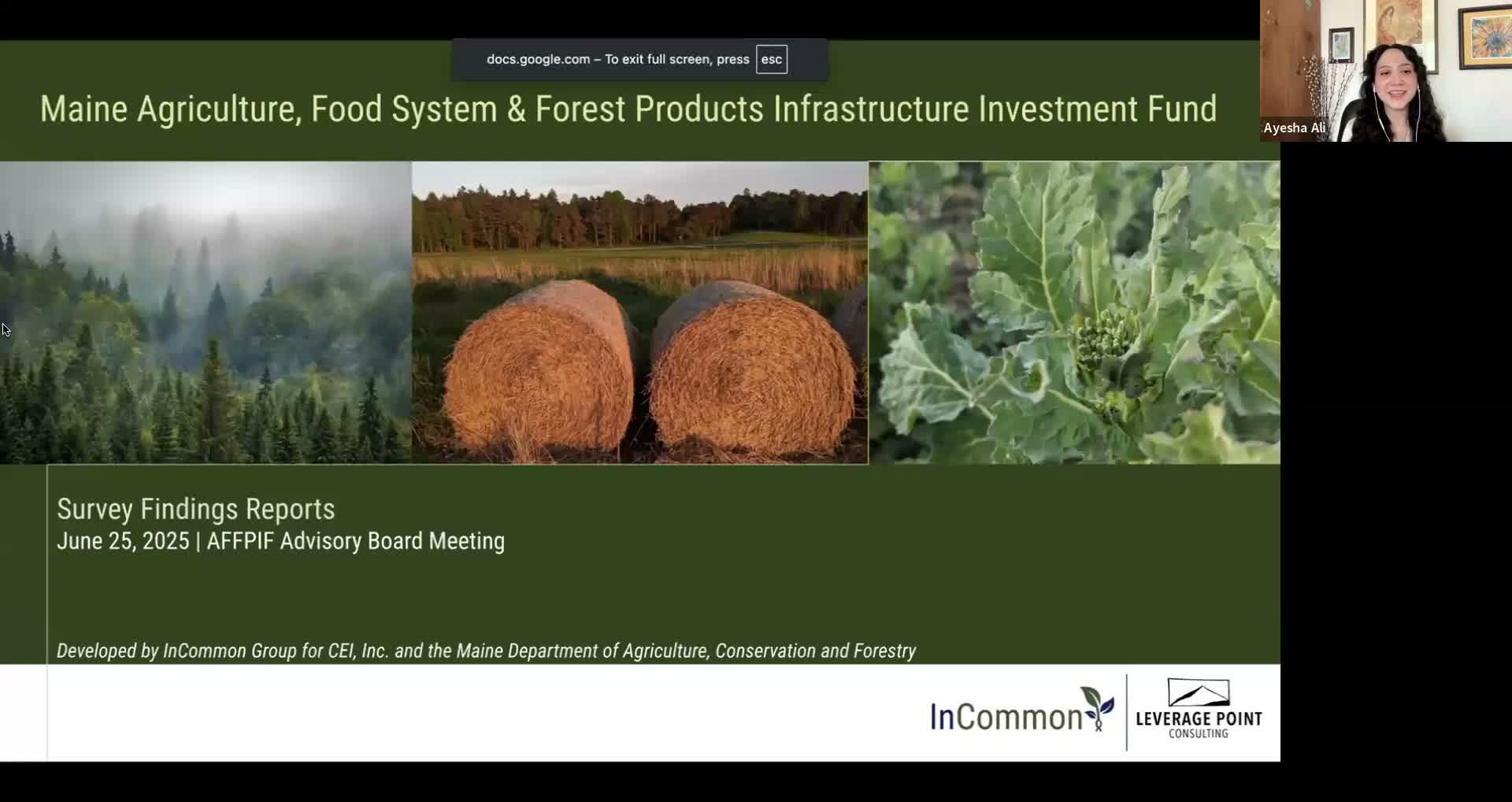
Summary
Department staff and advisory board members reviewed surveys of 178 farm/food/forest businesses and 57 capital/TA providers. Key takeaways: demand for low- or no-interest loans, simplified application processes, and targeted technical assistance for small and underserved operations.
The Agriculture, Conservation and Forestry, Department of convened its advisory board to review survey findings intended to shape a new fund for farm, food and forest businesses, highlighting demand for low- or no-interest financing, simpler application processes and tailored technical assistance.
Department staff member Jody summarized benchmarking and board feedback, saying the work points to “access to low interest loans is needed” and recommended considering different funding levels and simpler application tracks for smaller grants. Presenters reported 178 responses to the business survey and 57 responses to the capital and technical-assistance provider survey, providing the basis for cross-tabulated analysis.
Why it matters: the surveys identify barriers that could limit participation by small or historically marginalized producers — particularly match requirements and complicated applications. The meeting emphasized that a modest, well-targeted pilot could stretch limited public funds by reducing upfront match barriers and steering technical assistance to applicants who need it most.
Presenters flagged several consistent themes from the business survey: a plurality of respondents (35 percent) identified solely as farms; 41.1 percent reported annual revenue under $100,000; and the top-ranked forms of helpful capital were low- or no-interest loans, flexible repayment loans and tax credits. Presenting those findings, the survey team said 148 of 178 business respondents provided categorizable answers on historically marginalized status, yielding a roughly even split.
On barriers, Erica, one of the qualitative analysts, said capital access and financing were the most-cited constraints, listing high interest rates, cash-flow volatility, collateral and credit constraints, and the reimbursement model of some grants as common obstacles. She summarized technical-assistance findings by saying 60 percent of respondents reported no significant TA barriers, while the remaining 40 percent cited time, cost and access as problems; several respondents also said TA providers sometimes lack agriculture-specific experience.
Public comment reinforced the board’s findings. Catherine Piper, part owner of 5 Pillars Butchery, urged support for low- or no-interest loans, arguing that “the cost of the investment that we have to make to produce food can be astronomical” and that high interest obligations can threaten small producers’ viability.
Board members discussed resolving apparent contradictions in the TA findings — that many providers offer free TA while some businesses still report access problems — and asked staff to run further cross-tabulations to separate sectors and scales of business. Jody proposed requiring a baseline connection between TA and grantmaking while leaving flexibility for applicants to select TA providers.
Share-outs from breakout sessions reflected similar priorities. The farms group recommended prioritizing operations with revenue under $100,000 for production-equipment grants or 0% loans and providing pre-application TA; the food-processing and distribution group proposed piloting a tiered fund that includes small, no-match grants and a patient, low-interest repayment instrument designed to reduce risk for other investors.
Next steps: staff said they will run additional cross-tabulations, hold more TA-provider interviews, convene a forestry subgroup ahead of the next meeting and return in July with a draft fund framework and evaluation criteria.
The advisory board did not take formal votes at the session; staff described these outcomes as guidance that will shape a pilot using the $500,000 currently allocated to the fund.