
Advisory board leans toward grants-first approach for $500,000 AFIF round; debates tiers, TA and scoring
Get AI-powered insights, summaries, and transcripts
Subscribe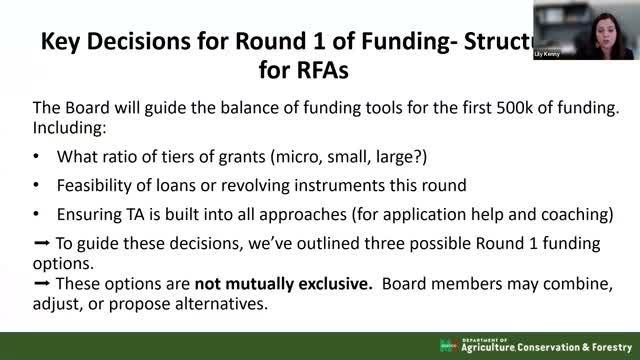
Summary
At a virtual advisory meeting, members generally favored a grants-first design for the $500,000 first round of the Maine Agricultural Food System and Forest Products Infrastructure Investment Fund, with microgrants and simple application rules prioritized. The board debated technical-assistance set-asides, whether to allow vehicles or software as infrastructure, and how to score applicants against statutory goals.
Senator Hickman presided over a virtual advisory meeting where board members weighed three design options for the fund's initial $500,000: (1) grants-only across micro, small and medium tiers; (2) a grants-first approach with a view to later loan programs; and (3) a hybrid that could include interest buy-downs for loans.
The department's staff lead, Lily, told members the fund is guided by statute and that rulemaking will set guardrails before any request for applications (RFA). "We know that this fund currently has $500,000 worth of funding," Lily said, framing the choice of whether that money should be divided into many small, accessible grants or reserved for larger awards and/or loan mechanisms. She emphasized equity, low-barrier applications and technical assistance as cross-cutting priorities.
Board members repeatedly favored keeping the first round simple and grants-focused. Jay, who identified his experience at FAME, said starting with grants avoids the extra administrative costs of standing up a loan program and helps put money in the hands of awardees more quickly: "If we do an evolving loan fund, we would have to hire a lending institution to administer the program, and it's very costly. It would just diminish what we can actually give out to awardees." Several breakout reports (forestry, food processing, agriculture) returned to the same conclusion: grants now, ideas about loans or interest buy-downs for future rounds.
Participants disagreed about whether to maintain multiple tiers (examples discussed included microgrants around $10,000—$15,000 and awards up to $50,000) or use a single tier with a single scoring rubric. Rada and others urged a single, simple scoring system this round to increase equitable access and to produce a broad set of winners that can demonstrate demand and build political support for future funding.
Technical assistance (TA) drew debate about scale and budgeting. Some members suggested reducing a proposed $50,000 TA set-aside to $25,000 so more money could reach direct awards; others cautioned that language access and individualized application help could be more expensive than assumed. Lily and participants agreed the RFA will need clearer definitions of what counts as TA, and whether TA funds are held back by the department or embedded in awards.
The board also discussed eligibility edge cases: vehicles (e.g., freezer vans) and software were debated as potentially eligible when they clearly support infrastructure or processing; soil amendments and certain energy-efficiency upgrades prompted questions about whether they fit the fund's infrastructure focus. Nicholas illustrated complexities about impact metrics with a practical example: "We recently purchased a $30,000 wild blueberry harvester, which actually cuts jobs," he said, arguing that job creation alone is a poor single metric for economic impact on small farms.
A major procedural point was scoring applicants. Several board members warned against asking reviewers to score broad statutory language such as "strengthening the state's agricultural, food and forest products economy" without breaking that concept into measurable items. Nicholas proposed using the statute's enumerated activities (e.g., processing, packaging, distribution) to create clearer, more objective scoring categories.
No formal votes were taken. Lily said she will gather written feedback and synthesize breakout notes for an October in-person meeting in Brewer, where the board expects to finalize RFA design and consider a co-chair nomination. The department and board members emphasized that round 1 should yield data to inform future rounds and that the process must keep underserved communities and low-barrier access central to the fund's design.
The board adjourned with a plan to reconvene in person on Oct. 29 to come to consensus on the final program design for the round 1 RFA.