Guam legislators hold hearing backing moratorium on deep sea mining, schedule emergency session
Summary
Guam lawmakers heard hours of testimony on Jan. 7 supporting Resolution 1 32-38, which urges a moratorium on deep sea mining and objects to BOEM's RFI (docket BOEM2025-0351); no vote was taken and an emergency full-legislature session was scheduled to consider the resolution before the RFI comment deadline.
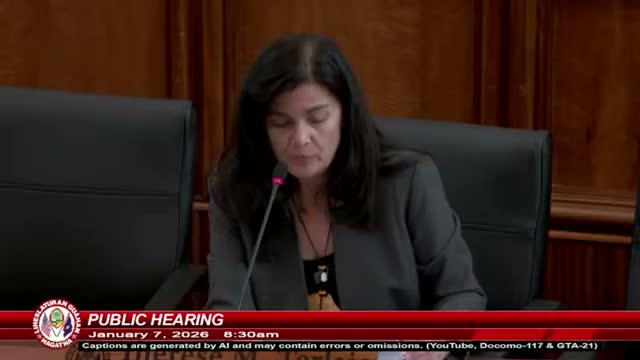
Senator Therese Terlahi chaired a Jan. 7 public hearing of the Guam Legislature’s committee on General Government Operations and Appropriations on Resolution 1 32-38, which would reaffirm Guam’s call for a moratorium on deep sea mining and formally object to the U.S. Bureau of Ocean Energy Management’s request for information on commercial leasing offshore the Commonwealth of the Northern Mariana Islands (BOEM docket BOEM2025-0351).
The hearing drew agency officials, scientists, legal experts and dozens of residents. Testimony united around concerns about scientific uncertainty, cultural and economic harms, and what witnesses described as an insufficient federal comment period. Julian Ogin, an attorney with Blue Ocean Law, told the committee that "the RFI rests on a deeply flawed assumption that the United States may unilaterally authorize seabed mineral extraction in the waters of Guam and the CNMI without consultation or consent" and argued the RFI and process are legally and procedurally deficient.
Why it matters: witnesses said the BOEM area — described by the committee as roughly 35,483,000 acres — lies close enough to Guam that sediment plumes and other impacts could cross maritime boundaries and harm fisheries, coral habitat and cultural sites. Agency witnesses warned that the RFI, issued on Nov. 12, 2025 with an initially short comment window, did not provide baseline scientific data and limited local jurisdictions' ability to respond.
Agency and scientific testimony: Chelsea Munia, director of the Guam Department of Agriculture, said BOEM’s RFI "is procedurally deficient, scientifically premature, and inconsistent with precautionary environmental governance," and urged suspension of docket BOEM2025-0351. Michelle Lastimosa, administrator of the Guam Environmental Protection Agency, said Guam EPA’s authority applies within territorial waters and reiterated that federal actions should meet NEPA and federal consistency requirements. Esther Tydigui of the Guam Coastal Management Program described federal consistency processes that would apply if permitting or leasing were proposed.
University and NGO perspectives reinforced the cautionary message. Austin Shelton of the University of Guam’s Center for Island Sustainability said scientists still lack key information about deep sea ecosystem function, sediment plume behavior and recovery timelines. David Henkin of Earthjustice said existing deep sea mining technologies would be "environmentally devastating" and called a moratorium "essential."
Community concerns and cultural framing: residents and representatives of indigenous and decolonization groups framed the issue as one of stewardship and rights. Guadalupe Melvin Wampat Borra, executive director of the Commission on Decolonization, testified that the RFI threatens Chamorro rights and self-determination. Multiple residents recounted personal, economic and cultural ties to coastal fishing grounds and urged lawmakers to protect those resources.
Legislative next steps: Speaker Frank Blas said the testimony validated an emergency approach and pledged to convene an emergency full-legislature session to consider the resolution; he said the session was tentatively scheduled for Friday at 9 a.m. and that written testimony would be accepted through noon the next day. No formal vote occurred during the Jan. 7 hearing.
Key factual details: the transcript record identifies BOEM docket BOEM2025-0351 and cites an RFI area of roughly 35,483,000 acres; witnesses said the RFI’s original comment deadline was Dec. 12, 2025 and was later extended to Jan. 12, 2026. The Bureau of Statistics and Plans noted the proposed mining site is about 120 miles from Guam.
What remains unresolved: the committee did not vote on Resolution 1 32-38 on Jan. 7; senators and testimony urged regional coordination (CNMI and other Pacific governments), possible legal avenues (UN mechanisms, NEPA, Coastal Zone Management Act federal consistency) and local legislative options such as a territorial ban on seabed mining. The emergency session will determine whether the Legislature formally forwards a resolution objecting to BOEM’s RFI.