Get Full Government Meeting Transcripts, Videos, & Alerts Forever!
Get email alerts on the Training And Governance topic
No spam. Unsubscribe anytime.
Bangor Planning Board members receive annual training on public‑meeting law, ethics and stormwater rules
Summary
After the code-amendment item, planning staff and the assistant city solicitor led annual training for board members covering due process, Freedom of Access Act obligations, conflicts of interest, and stormwater permit requirements and best-management practices.
Following the public hearing and vote on the arterial-definition amendment, the Bangor Planning Board held its annual training session for board members and staff.
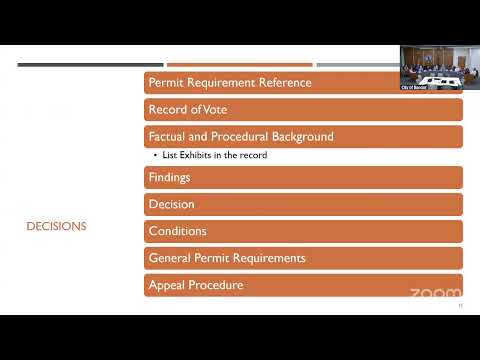
Grace Innes, assistant city solicitor, reviewed due process for quasi‑judicial decision-making, the Freedom of Access Act (public‑records and public‑meetings obligations), ex parte contacts and permissible executive-session uses. Innes emphasized that board members must base decisions on the evidence presented at hearings and disclosed a preference that members maintain separate email addresses for board business to facilitate public‑records responses. "Members of public bodies . . . may not discriminate unlawfully," Innes said, and she walked the board through conflict‑of‑interest procedures that require disclosure and, if necessary, stepping down from participation while remaining in the room as a private citizen if they choose.
Rich May of the engineering department summarized Bangor's stormwater permitting obligations with the Maine DEP. He explained the permit's minimum control measures, including public education and involvement, illicit-discharge detection and construction-site erosion control, and said the city requires annual inspection and certification of on-site stormwater treatment features such as bioretention cells and wet ponds. May noted the permit regime is evolving and that a potential new permit after 2027 could raise compliance requirements further.
Staff also reviewed the planning board's roles under Chapter 23 of the code, the difference between zoning (policy) and permitting (implementation), and procedural elements of site-plan and subdivision review, including when conditional-use findings are required and when bonds or guarantees may be applied for public improvements.
The board used the training session for clarifying questions about recusal procedure, the distinction between definition changes and rezoning, and when the board should ask applicants for additional guarantees such as decommissioning bonds on projects that could be abandoned. The session concluded and the chair adjourned the meeting at 9:16 p.m.