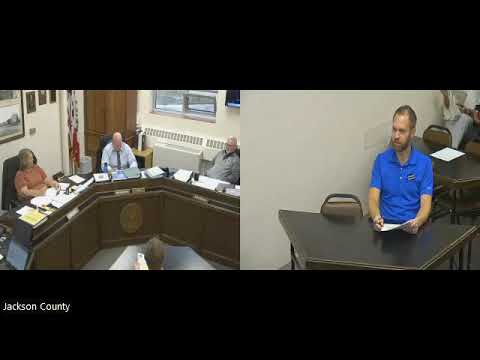
Jackson County board and area mayors debate regional 911 dispatch plan, funding options
Loading...
Summary
Mayors and county supervisors spent the bulk of the Jan. 6 meeting debating a proposed 28E dispatch agreement and whether to finance regional dispatch through a countywide EMA levy or intergovernmental cost-sharing (per-capita or property-valuation). Supervisors asked the county attorney to review legal options and set a short work session to refine numbers and language.
Representatives from several cities asked the Jackson County Board of Supervisors on Jan. 6 to consider a formal intergovernmental agreement to stabilize 911 dispatch staffing and pay.
Mayor Josh Bolt, addressing the board, said cities want an agreement that preserves service continuity while resolving salary and budget shortfalls; he presented two funding options that had been discussed with city officials: option A would keep dispatch as city employees with an intergovernmental (28E) cost-share; option B would rely on a county levy (an EMA levy) and convert dispatch to county employees. "I don't necessarily believe the city is in full alignment with the others about this — it's our preference to keep the employees," Bolt told supervisors. "How we get there seems to be impossibly difficult at times."
The proposal prompted extended questions from supervisors about cost allocation and long-term risk. Chair Don Swinker said he favored an allocation tied to population because "people call 911," and warned that shifting the entire cost to the county could leave supervisors responsible for transition expenses later. Several supervisors urged caution, noting that the county lacks reserves to absorb a large one-time transfer of assets or equipment: board members discussed preliminary transition cost estimates that ranged into the hundreds of thousands or potentially millions of dollars.
County and city staff debated how to divide costs if cities and the county agreed to share them. Kelly Brown, identified as director of the Jackson County Economic Alliance, summarized the practical limits of a population-only approach and observed that property valuation inevitably affects tax incidence: "You just can't get away from valuation," Brown said, noting that property tax mechanics shift the burden toward higher-valued parcels. Several city representatives and supervisors also asked whether dispatch could be added to the county's existing EMA (emergency management) levy; staff said that could be a path but cautioned it may require legal review or code changes.
Supervisors repeatedly pressed for clarity on three items before taking any final step: accurate numbers showing how each option affects city and county budgets, clear legal guidance on whether dispatch may be included under an EMA levy, and negotiated language that protects Jackson County from unaffordable transition costs if a county takeover later occurs. Several supervisors recommended a county work session and follow-up with the county attorney to draft or revise agreement language.
The board did not vote on a governance change. Chair Swinker asked county staff to work with city representatives and the county attorney and requested a follow-up work session within a few weeks to review updated numbers and proposed contract language. The board also agreed that staff should send letters and continue discussions with city partners while the legal and fiscal questions are resolved.
Next steps: the board asked staff to return with clarified cost allocations, legal advice on EMA levy inclusion, and proposed contract revisions for review at the scheduled work session.