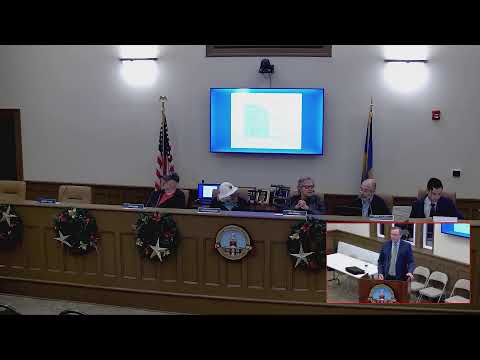
Georgetown board grants 2‑foot height variance for Kingfisher Court apartments
Loading...
Summary
The Board of Adjustment unanimously approved a 2‑foot variance allowing mean building height to increase from 35 to 37 feet so developer A.H. Davenport LLC can proceed with three‑story, pitched‑roof apartment buildings for the Kingfisher Court project; 15% of units are reserved under a Mixed Income Market Fund covenant.
The Georgetown Board of Adjustment voted unanimously to grant a 2‑foot height variance for the Kingfisher Court apartment project, allowing the mean roof height to increase from 35 to 37 feet so the developer can construct three‑story buildings with pitched roofs.
David Hutt, a local attorney with the law firm Morris James representing A.H. Davenport LLC, told the board the site plan for the project is recorded and building permits require the variance because the mean height of the pitched roofs measures 37 feet under the town’s definition. “The request tonight is for a 2 foot variance from 35 to 37 feet,” Hutt said, describing six buildings totaling 106 apartments (five buildings with 18 units and one with 16 units).
Hutt outlined the legal standard the board should apply, citing the Delaware Supreme Court’s four‑factor “quick check” test for area variances: the nature of the zoning district, the character of the immediate vicinity, whether removal of the restriction would harm neighbors, and whether the restriction creates an exceptional practical difficulty for the owner. He argued the property lies in MR‑1 multifamily residential zoning and abuts a mix of residential, commercial and institutional uses, including the Purdue campus (zoned LI‑2), and that 37 feet would be lower than the height allowed on adjacent LI‑2 property.
Hutt also presented design materials showing gabled roofs, dormers and other pitched‑roof elements and said that modern three‑story apartments with 9‑foot ceiling heights and pitched roofs need the 37‑foot mean height to meet the town’s development design standards and avoid flat roofs that would be out of character with Georgetown’s residential architecture. He noted the project’s affordable‑housing commitment: the developer engaged the Delaware State Housing Authority’s Mixed Income Market Fund (MIMF), and 15% of the units (16 units) must be leased to households at 65% of area median income or less; that restriction is recorded as a covenant in the Recorder of Deeds.
Town staff and the board clarified technical points: the zoning code measures pitched roofs to the mean height between eaves and ridge (section 2‑30‑5, as cited in the presentation), which is why the mean height — not the absolute peak of about 41 feet — governs the variance calculation. Alex Burns, the board’s attorney, characterized the request as an area (dimensional) variance and confirmed the legal framework the board should use.
Commissioners who spoke supported the application. Commissioner Tom Baker said the higher wall heights (9 feet) and the design rationale supported the request; Commissioner Ron Howard praised the design and said the two‑foot difference was modest. Baker and Howard stated practical reasons for approval and the board voted to grant the variance.
After the variance vote the board approved meeting minutes from Nov. 5 and then adjourned. No correspondence for or against the application was reported to the board prior to the hearing.