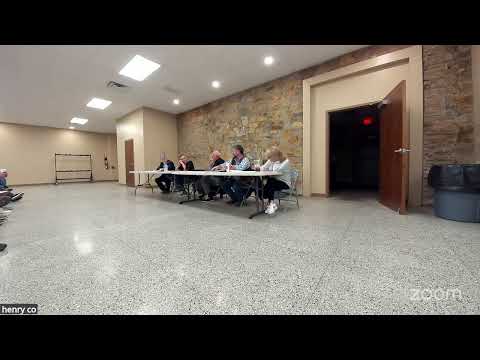
Henry County commissioners debate PUD for tech campus, raise water, emissions and plan-consistency concerns
Loading...
Summary
At a Jan. 17 work session, Henry County commissioners reviewed an outline for a proposed Henry County Technology PUD that could allow a data center and other heavy-industrial uses; commissioners pressed for measurable commitments on water use, emissions monitoring and whether the PUD aligns with the 2018 comprehensive plan.
Henry County commissioners reviewed an outline plan for a proposed "Henry County Technology" planned unit development during a work session, with discussion centering on whether the PUD’s heavy‑industrial allowances — including possible data center use — conflict with the county’s 2018 comprehensive plan and whether the PUD contains measurable environmental safeguards.
Joel, the board’s requested presenter, described a planned unit development as "a zoning district" that "allows for development that mixes uses that would not otherwise be allowed in any 1 single district," and explained the commission’s role is to approve the outline plan after the planning commission’s recommendation. "If you were to adopt the plan commission recommendation, it would create a unit development district," Joel said, outlining that later, more detailed development plans would generally be handled by the planning commission.
Commissioner Susan said she believed the PUD’s claim of compliance with the comprehensive plan was incorrect. She pointed to language in the plan that designates parts of the project site as "prime agricultural land" and recommends protecting such land and discouraging extensions of city services, such as sewer lines. "I think that this PUD is inconsistent with our comprehensive plan," Susan said, urging commissioners to follow prior planning work rather than discard it when inconvenient.
Susan pressed the board for measurable commitments in the PUD on resource and environmental protections. She said she found no numerical limit on water use and noted developer discussions about extending municipal water infrastructure to the site. "I did not read any commitment regarding an amount of water that will be used," she said, and added that the county’s aquifer "is precipitation fed only and is lowering over time," creating concern that a large water user could have a negative effect on local groundwater.
On air quality and energy, Susan said she saw no specific emissions limits or required technology in the PUD and questioned assertions about the project’s effect on the grid. Recounting an analysis she received, she said the CO2 output from the proposed on‑site natural‑gas generation could be substantially greater than emissions represented by trucks at a nearby truck stop, and requested exact CO2 figures and "any protection or air quality monitoring" proposed in the plan.
Joel and other commissioners described how the process would proceed. The board discussed that approval of the outline plan is the commission’s principal step and that detailed technical matters — such as final siting, water availability, gas line routing and other infrastructure questions — would be addressed during later development plan review or by a technical review committee. Joel warned that statements by developers would not change the submitted PUD document and would typically serve as technical input rather than altering the outline plan.
The board agreed to a public hearing scheduled for Jan. 17. Commissioners sketched a two‑hour hearing format with roughly 30 minutes for proponents, 30 minutes for opponents, 30 minutes for developers, and 30 minutes for zoning/legal presentation, and suggested limiting individuals to about three minutes each. Joel noted there is a roughly 90‑day window after planning commission certification (cited in the discussion as "around Feb. 20") tied to the statutory process; commissioners said they expected to take a formal vote at a subsequent commissioners meeting after the hearing and a period of reflection.
No formal motions on the PUD were taken at the work session; commissioners moved to adjourn at the end of the discussion. The public hearing remains scheduled for Jan. 17, and the board indicated it would consider the PUD for formal action at a later, specified commissioners meeting following the hearing and any required statutory timelines.