
Cabarrus County board hears warnings of sustained overcrowding in northwest elementary schools
Get AI-powered insights, summaries, and transcripts
Sign Up Free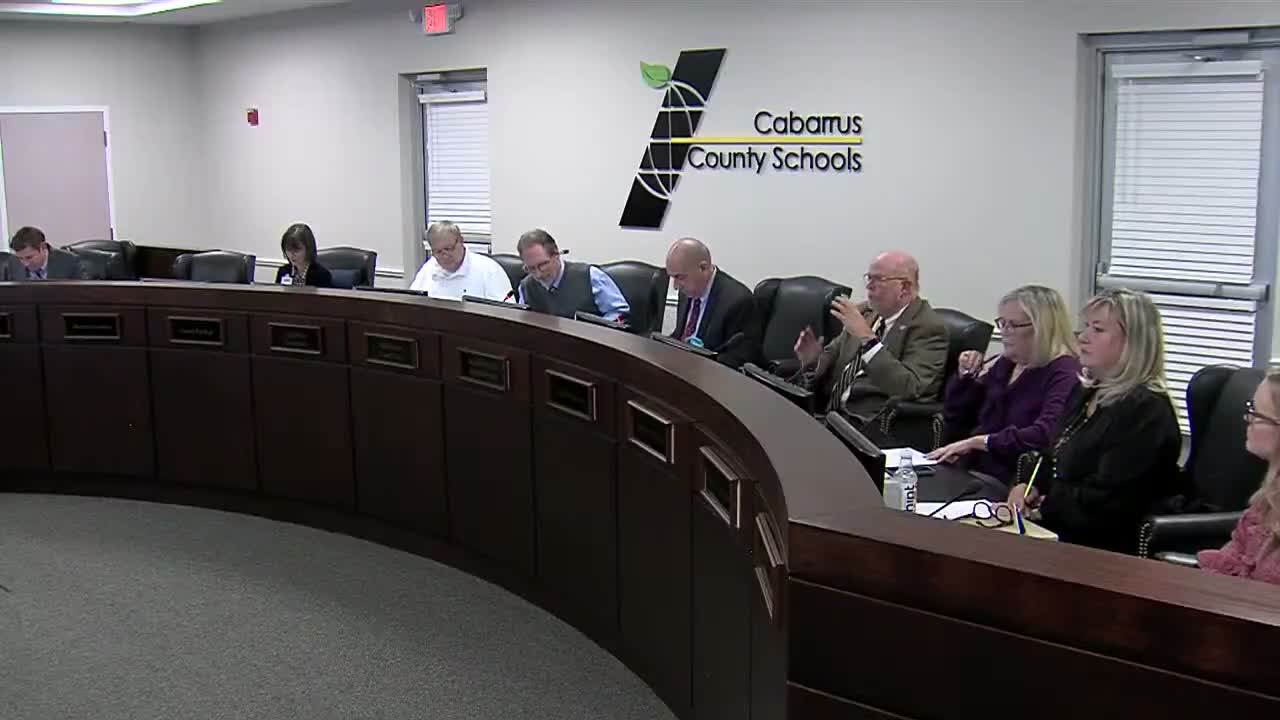
Summary
District staff presented projections showing several northwest elementary schools above 120% design utilization and outlined short-term relief options — modular classrooms, targeted capping or overflow schools — while the board asked staff to return with a recommendation by Feb.–March.
Cabarrus County Schools staff told the Board of Education on Jan. 5 that continuing enrollment growth in the northwest sector could leave multiple elementary schools persistently over capacity and that short-term relief will be needed before a planned new school opens.
Dr. Jonathan Bowers, presenting district enrollment projections and density maps, said enrollment trends and state-demographer projections show several elementary schools in the northwest may remain above the district’s 120% utilization threshold for the next five years. "We fully anticipate that elementary school ... opening its doors in the fall of 2028," Bowers said, while cautioning that 2028 is roughly two and a half school years away from providing relief.
Bowers explained how the district computes utilization against design capacity and showed that the northwest region has moved from two schools above 120% in 2019–20 to four today, with Odell Primary and Odell Elementary singled out for particularly high projected utilization. He warned that modular units are temporary relief and do not expand core facilities such as cafeterias or gyms.
Board member and parent Pam Escobar described on-site effects she has observed at Cox Mill Elementary: "When your kids go to a school that is over capacity ... lunch is very short — to the point where my kids chose to bring their lunch because they couldn't eat fast enough to get through the line." Escobar also raised safety concerns for students in modular cottages during severe‑weather events.
The district presented four informational options: keep the current model and accept growth; add modular units (Bowers estimated roughly $2 million ballpark cost for modulars); set a hard cap on enrollment at affected boundaries (which would limit new enrollments and shift students to overflow schools); or apply a limited, targeted cap to highest-yield neighborhoods. Bowers gave a transport-cost example tied to capping: "It costs about $5.13 to transport a student one mile," he said, and estimated roughly $225,000 annually in additional transport costs under a capping scenario (staff noted the figure would vary with fuel and other factors).
Board members pressed staff for demographic and equity analysis before any cap: "Are those high-density neighborhoods going to be lower income?" asked a board member, and staff replied that such demographic impacts would be part of further analysis should the board direct exploration of capping.
The board did not take formal action. Staff said they will return with a recommendation within roughly one to two months and suggested discussing the topic in depth at the upcoming board retreat, with a target of a February–March timeline for a final recommendation.
Next steps: staff will produce additional demographic, transportation and timeline analyses and present a recommendation to the board for action at a future meeting.