
Lake County board approves first reading of zoning changes to implement housing element, adopts internal expedited‑processing policy
Get AI-powered insights, summaries, and transcripts
Subscribe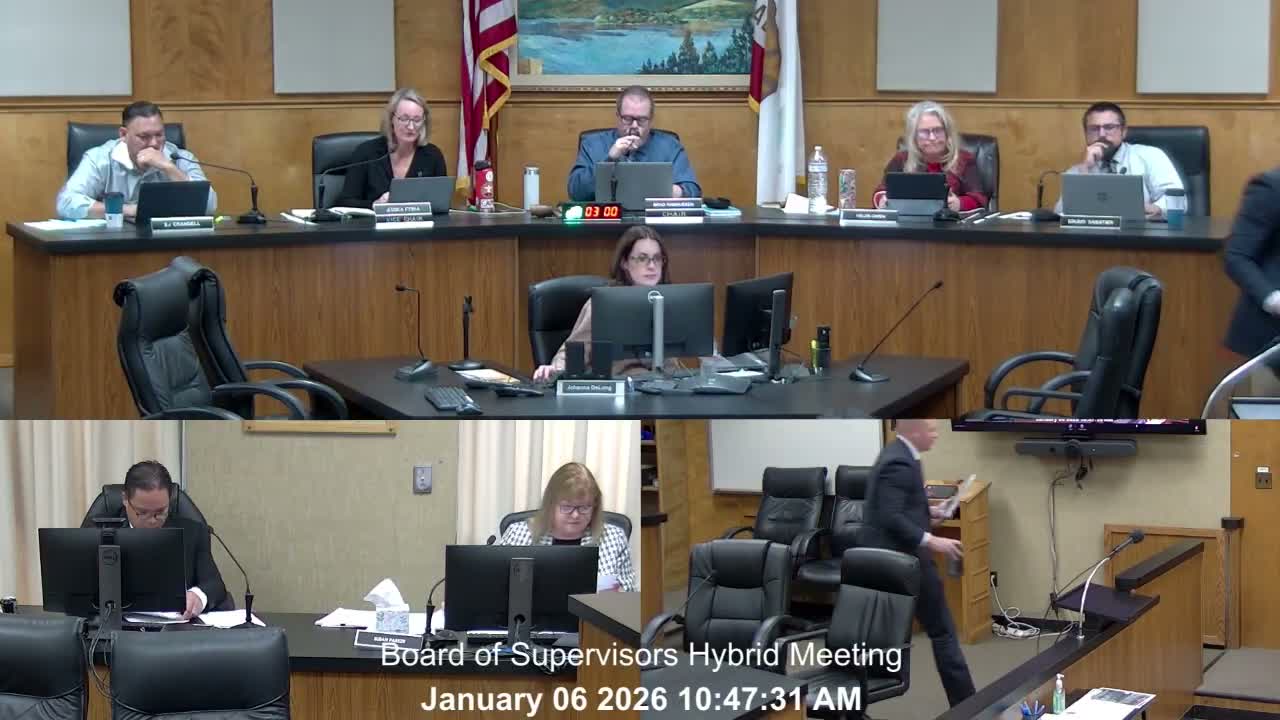
Summary
The Lake County Board of Supervisors voted 4–1 to approve first reading of an ordinance amending Chapter 21 of the county zoning code to implement remaining sixth‑cycle housing element policies and adopted an internal Community Development Department policy to fast‑track qualifying affordable housing projects; staff cited a negotiated state deadline and HCD oversight.
The Lake County Board of Supervisors on an announced deadline advanced a package of zoning amendments intended to implement remaining tasks from the county’s sixth‑cycle housing element and adopted an internal policy to expedite qualifying affordable housing projects.
Community Development Director Maria Turner told the board the proposed ordinance would amend Chapter 21 of the Lake County Zoning Code to implement multiple housing element policies (HE‑38, HE‑59, HE‑60, HE‑61, HE‑71, HE‑72 and HE‑73) and that the county must show the state those implementation steps before starting the seventh‑cycle housing element. Turner said the housing element “is a chapter of the Lake County general plan” and described the amendments as primarily lifting certain permit barriers and aligning county rules with state law.
The ordinance package includes allowing additional residential and mixed‑use development in commercial areas where services exist (HE‑38); allowing supportive housing by right where support services are available; setting a 180‑day maximum stay for emergency shelters and removing a 300‑foot buffer (HE‑60); permitting agricultural employee housing of 6–12 units or up to 36 beds in zones that allow agriculture; allowing residential units above commercial uses without a minor‑use permit and without added parking (HE‑71); removing the minor‑use permit requirement for multifamily developments of 20 or more units (HE‑72); and enabling low‑barrier navigation centers to comply with state law (HE‑73). Turner said staff considers these actions to be within the scope of the general plan EIR and therefore not to create additional CEQA impacts.
Why it mattered
Turner said the county negotiated a final timeline with the California Department of Housing and Community Development (HCD) and needs to demonstrate implementation steps to avoid potential penalties. She told the board she had negotiated the deadline with HCD and that the county had previously approved these tasks in the 2019 housing element that the state certified in 2020.
Board and public reaction
Supervisor Sabatier expressed strong reservations, saying zoning is not the primary barrier to housing in Lake County and arguing that construction costs and market economics are the real constraints. “There’s a reason we don’t build housing here and it’s not because of our zoning,” he said, adding concerns about parking and the county’s limited infrastructure.
Supervisor Hahn and Supervisor Pyska echoed parking and infrastructure concerns: Hahn noted limited public transit and worried that relaxing parking requirements would cause on‑street congestion; Pyska pointed out many areas are on septic and lack curbs, gutters and wide streets, which could limit where these changes are practical.
Several members of the public urged caution. Margo Kambara asked the county to seek more time from the state and warned of potential environmental justice harms if low‑income communities receive rapid, unplanned growth. Angela Amaral said the county should not treat the changes as one‑size‑fits‑all and asked whether the county responded to an HCD letter dated 07/08/2025 that set a November 2025 deadline. Holly Harris of Clear Lake Oaks raised drafting and technical concerns including missing definitions for “qualifying projects,” inconsistent cross‑references in the ordinance text, and a lack of a published list of identified affordable housing sites from the sixth cycle.
Staff offered clarifications: Turner said the ordinance followed the noticed public hearing process, that definitions referenced in the draft appear in Article 68 (page 14), and that staff will post a map of parcels from prior cycles (fifth and sixth) showing candidate sites in North Lakeport, Upper Lake, Kelseyville, Lower Lake and Middletown.
Action and next steps
Supervisor Pyska moved to approve first reading of the ordinance; the motion was seconded and carried 4–1. The board then voted to advance the ordinance to the next available board agenda. The board also adopted the internal Community Development Department policy to implement HE‑6 (expedited processing for qualifying affordable projects); that action passed 4–1, with Supervisor Hahn recorded as opposed on the adoption vote. Turner said the county will post maps of identified parcels online and begin preparations for the seventh‑cycle housing element later this year.
What remains unclear
Members and public commenters asked for clearer definitions: the draft policy references “qualifying projects” and a threshold described as a “significant portion” of restricted units but does not list numeric criteria in the ordinance text; Holly Harris said there is no explicit definition of the expedited‑project standard in the draft. Turner said definitions are included in Article 68 and staff will provide the parcel map and additional materials online.
Procedural note
Staff recommended first reading and adoption of the internal policy; the board approved those recommendations in voice/roll‑call votes and advanced the ordinance for formal adoption at a later meeting.