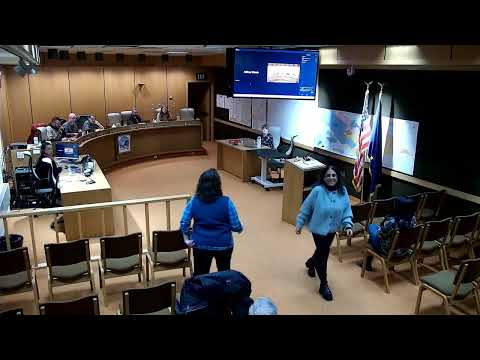
Assembly reviews fishery-disaster funds and several contracts; approves emergency Port Lions fire-alarm upgrade
Loading...
Summary
The assembly reviewed ordinances to accept federal fishery-disaster payments, questioned a high bid for a landfill-scale platform (requested advisory-board input), and approved expedited replacement of a malfunctioning Port Lions school fire-alarm panel; building automation/KFRC monitoring contracts were discussed with support for an initial full-service monitoring term.
At the Dec. 16 work session the assembly reviewed several ordinances and contracts: staff presented ordinances to accept one-time federal disaster payments of $156,158.40 (2020 Alaska Pacific cod disaster) and $41,557.81 (2021 Chignik salmon disaster) to the fisheries economic development fund, and the assembly opened discussion to allow public input on allocation when the ordinance is presented for adoption.
Contract reviews drew intensive questions. A proposed $214,000 bid for a new landfill-scale platform prompted several members to ask for additional justification and recommended referral to the Solid Waste Advisory Board; staff explained the bid covers a full-length platform expansion to improve safety and access, not simply a like-for-like wood replacement.
Because a school fire-alarm panel at Port Lions was malfunctioning (repeated false alarms), staff issued an emergency RFP and identified Taylor Fire as the lowest responsive, responsible bidder; staff recommended expediting the upgrade, and the assembly expressed support for moving forward with that emergency procurement. The school district offered up to $50,000 toward the project.
The assembly also discussed renewing building-automation and KFRC monitoring licenses with Long Building Technologies. Staff recommended a full-service monitoring option for the first year at an annual cost of about $31,281 for KFRC (no lock-in to five years; staff said the vendor provided a five-year price guarantee) to protect research tenants and equipment; members expressed support, especially given tenant cost-sharing and the complexity of the research facility.
No final appropriations were adopted for most items at the work session; staff will return with formal ordinances, contracts and fiscal notes as needed.