
Zionsville BZA upholds staff finding that Love Pet Project site functions as a kennel
Get AI-powered insights, summaries, and transcripts
Subscribe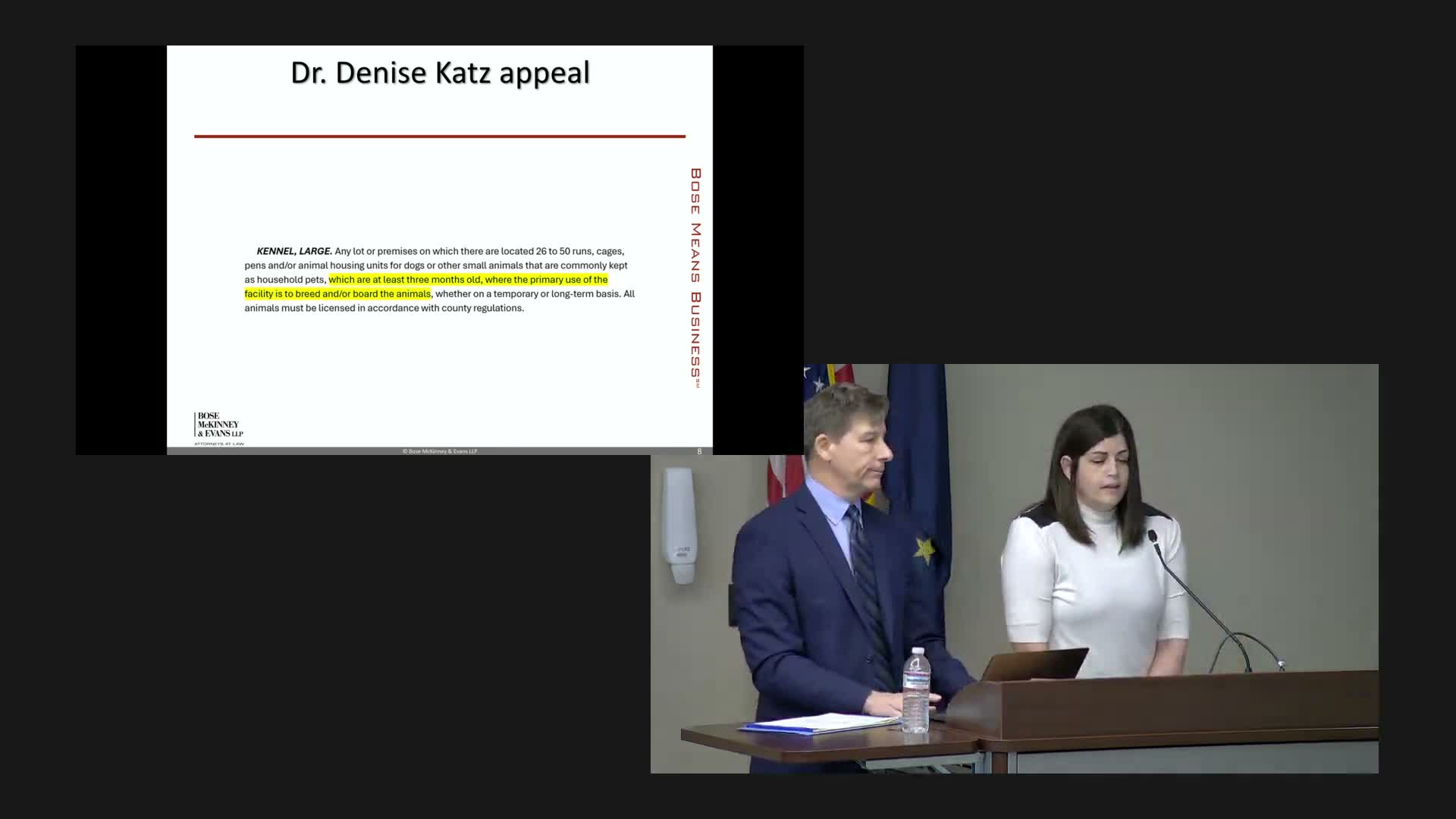
Summary
On Jan. 7, 2026, the Zionsville Board of Zoning Appeals denied an appeal from Dr. Denise Katz and upheld a staff determination that the property at 9855 E. 100 S. is operating as a kennel; the decision followed contested testimony about ownership, microchipping, adoption donations and neighborhood noise.
The Town of Zionsville Board of Zoning Appeals on Jan. 7 denied an administrative appeal from Dr. Denise Katz, upholding a staff determination that a property at 9855 East 100 South is functioning as a kennel in violation of the R‑2 zoning district.
Staff told the board the complaint process began Oct. 6, 2025, with a neighbor report of 60–70 dogs and on Oct. 10 a staff inspection that found at least 30 dogs, two goats and three possible employees on site. Staff said photos and website content linked the Love Pet Project nonprofit to the property and cited adoption‑related fees as a form of monetary compensation, concluding the operation aligns with the ordinance’s kennel definitions.
Dr. Denise Katz, introduced by attorney Steve Grove, disputed the finding. Katz said she owns the animals, operates the Love Pet Project (registered as a 501(c)(3)), maintains USDA and state records and microchips animals to herself, and that the site’s animals are not being bred or boarded for financial gain. Katz told the board she had 50 animals on the property that day, including 38 dogs, and that roughly 70 percent of dogs are three months old or younger because the rescue focuses on medical cases and puppies.
Neighbors offered conflicting testimony. Attorney Mike Andreoli, speaking for adjacent residents, pointed to photos and videos on the Love Pet Project website that show animals at the property and argued that donations and adoption fees constitute monetary compensation. Ann Marie Nelson, whose property adjoins the site, described persistent barking and noise that she said had reduced use of her outdoor spaces and said the operation had expanded over time. A different nearby resident, Nick Laviolette, said he and his family have no noise complaints and described Katz as a generous neighbor.
Board members discussed ordinance language and evidentiary gaps, noting the Zionsville code defines small, large and unlimited kennels (requiring that the primary purpose of the facility is to breed or board animals) but does not separately define “boarding.” Several members said the facts suggested more than typical pet ownership where on‑site staff and routine off‑site adoptions appear to occur.
After deliberation a member moved to deny the appeal, the motion was seconded, and the board voted to deny the appeal; the chair announced the motion carries and the staff determination was upheld. The denial means the planning director’s determination that the use is a nonpermitted kennel in R‑2 zoning stands and any next steps (fines, compliance orders, or further administrative appeals) would follow town enforcement procedures.
The board’s action focused on the application of kennel definitions in the zoning code and evidence of on‑site operations tied to Love Pet Project. The meeting record includes differing accounts about counts of animals, whether the presence of staff and a mobile clinic amounts to boarding, and whether adoption donations amount to financial compensation under the ordinance; those factual debates were central to the board’s decision.
The board did not adopt a separate enforcement remedy on the record beyond denying the appeal. The chair closed the matter and the meeting proceeded to other agenda items.