
Palo Alto finance committee advances revised investment policy, shifts to active management
Get AI-powered insights, summaries, and transcripts
Subscribe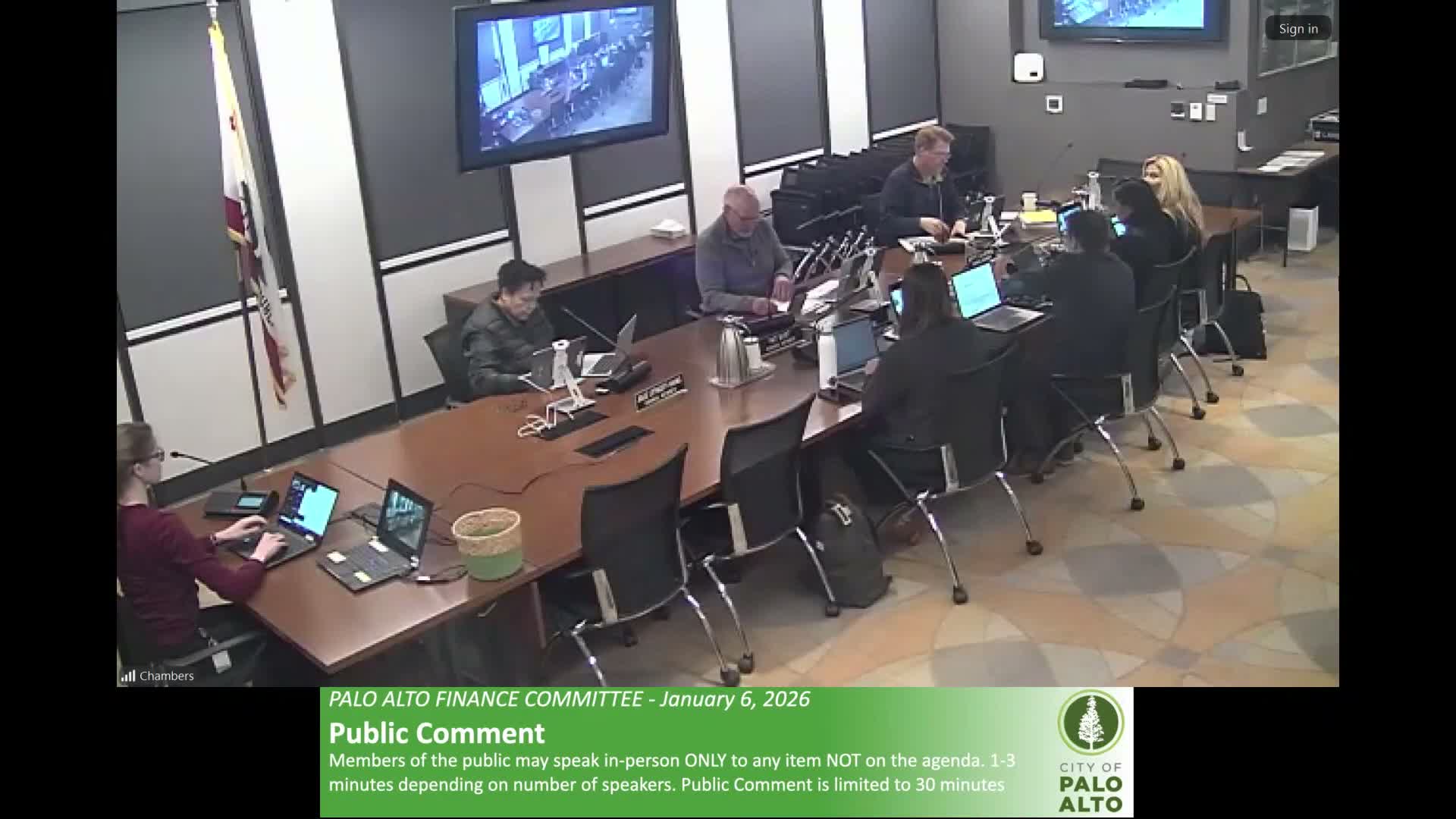
Summary
The Palo Alto Finance Committee voted unanimously to forward staff-recommended revisions to the city's investment policy to the full council. The changes authorize more active portfolio management, switch reporting to market value, expand allowable corporate credit to single-A with mitigation, and add operational controls with Chandler Asset Management.
The Palo Alto Finance Committee voted unanimously Jan. 6 to advance revisions to the city's investment policy that will allow more active management of the municipal portfolio, change reporting from par value to market value, and broaden the pool of allowable corporate investments while adding new safeguards and compliance checks.
Lauren Lai, the city's chief financial officer, opened the presentation and said staff worked with Chandler Asset Management on a comprehensive review to align the policy with state law and city priorities of safety, liquidity and return. "We're excited to bring this item back to you," Lai told committee members.
Chandler's presenters told the committee the policy removes a strict hold-to-maturity approach to permit tactical sales before maturity when doing so is projected to improve long-term portfolio return and better align duration. "We're allowing tactical sales before maturity so that we're able to flex with the changing market," a Chandler representative said, describing the firm's proposed approach to balancing realized gains and losses against reinvestment opportunities.
The revisions also shift internal reporting from par (amortized) value to market value. Presenters said market-value reporting gives policymakers a more immediate view of portfolio worth and aligns required accounting disclosures under the Governmental Accounting Standards Board.
A significant technical change would permit purchases of single-A rated corporate medium-term notes, expanding the investable universe from a narrower set of double-A and higher credits. Chandler cautioned the additional yield from moving to single-A is modest—15 basis points in many cases, but argued the move would improve diversification across sectors such as technology, insurance and consumer staples. Chandler said portfolio risks would be mitigated by a multi-step credit-analysis process, a dynamic approved-issuer list, and an issuer-concentration threshold written into policy (a 5% issuer threshold was described in the presentation as a policy-level cap, while portfolio managers typically seek much smaller practical exposure per-name).
Committee members asked detailed questions about how the policy would handle downgrades, liquidity and potential losses. Presenters said California law governs compliance at the time of purchase and does not require an automatic sale after a downgrade; instead staff and the adviser would notify the city team and recommend a course of action based on the credit committee's analysis. Chandler described pre-trade compliance rules embedded in Bloomberg AIM that block nonconforming trades, daily and monthly post-trade review, and quarterly compliance reporting to the council.
Other updates in the policy include revised concentration limits for certain categories, expanded recognition of nationally recognized statistical rating organizations to match California Government Code language, a clearer treatment of collateralized bank deposits and negotiable certificates of deposit above FDIC limits, and provisions for joint-powers-authority investment pools.
Committee members debated policy wording that would require restoring concentration limits "as soon as possible" after market-driven deviations. Several members asked staff to replace the phrase with clearer timing (for example, restoration "as investments mature" or within a "reasonable" period) to avoid forcing disadvantageous trades; staff agreed to refine that language before the item goes to full council.
A committee member also urged staff to include a brief preamble in the council packet explaining why the city engaged Chandler Asset Management and how the adviser's work fits into the city's multi-year budget assumptions. "What are we getting out of this?" one member asked; staff said they would consider conservative projections for council-level materials.
After discussion the committee moved to approve the recommended revisions as incorporated in the packet (attachment B). A council member moved the motion and another seconded; the committee voted in favor and the motion passed unanimously. Staff said it will incorporate the committee's feedback and forward the revised policy to the City Council for final action.
Authorities and next steps noted in the meeting included references to California Government Code provisions governing permissible investments and accounting guidance under GASB. The committee's action was a recommendation to the full council; the revised policy will return to council for adoption and further public review at that meeting.
(For accuracy: the committee recorded no public speakers on the item and the motion passed unanimously.)