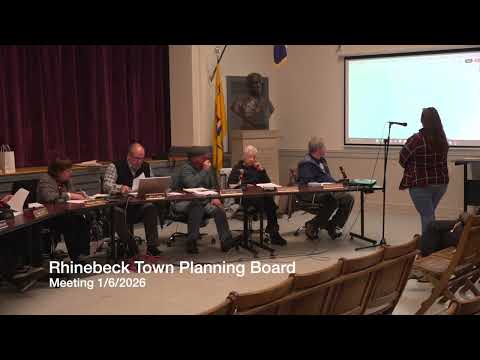
Rhinebeck planning board continues hearing on proposed Rhinebeck Villas hotel after extended debate over wells, wastewater and Route 9G traffic
Loading...
Summary
The Rhinebeck Planning Board continued its public hearing on a proposed hotel development, "Rhinebeck Villas," to Feb. 2 after multi-hour discussion about well testing, the planned wastewater treatment system, and potential off‑site traffic impacts on Route 9G; board members asked the applicant to return with technical experts and additional documentation.
The Rhinebeck Planning Board on Jan. 6 left open a public hearing on the proposed Rhinebeck Villas hotel and asked the applicant to return Feb. 2 with technical experts and additional documentation to address outstanding SEQRA (referred to in the record as “Seeker/SECRA”) questions.
The applicant’s representative, Sean, told the board the team had provided supplemental materials (including a December 22 letter, neighbor notice lists and well‑testing data) and said county health authorities had approved the on‑site well. He said three neighbors participated in well testing and that hydrogeologists and contractors had reviewed results. The applicant also offered diagrams for the proposed wastewater treatment facility and said nearby landowners (identified in the submission as “4 Brothers”) had agreed to allow sidewalk expansion onto their property.
Board members pushed back on several technical points. Planning staff (Jim) noted the short EAF lacked some numeric estimates — notably projected energy use and certain septic emission details — and reminded the board that the town’s SEQRA/SECRA review could require additional study or mitigation if the action were found to have a moderate or large impact. Multiple board members said a three‑well sample for water availability was a small dataset for a development of the project’s proposed scale and asked for more hydrogeologic detail and documentation from the county health department.
Traffic was a central concern. Members discussed whether the project’s off‑site impacts at the Route 9G/Middle Road intersection should prompt the town to hire an independent traffic reviewer. The applicant declined to pay for an outside study; some board members said the town could hire a consultant with public funds if it deemed the extra review necessary. Staff and members noted that driveway design and any permit for access onto Route 9G fall under New York State Department of Transportation jurisdiction and that DOT permitting and engineering would still be required.
On visual impacts and aesthetics, staff described Route 9G as a publicly accessible scenic corridor and said the board had asked for renderings showing what the proposed treatment plant and buildings would look like from public vantage points. The applicant provided images and a “worst‑case” box size for the wastewater unit; board members asked for clearer renderings and a landscaping/screening plan to evaluate whether visual impacts could be mitigated at the site‑plan stage.
The board also reviewed EAF items about energy, noise and lighting: applicants indicated use of efficient heat‑pump systems and dark‑sky, full cut‑off lighting, and staff said the project as presented would not trigger state air‑emission thresholds. Noise from construction and operations was characterized as manageable under the town’s noise code provided contractors and future operators comply with local standards.
After extended exchanges among board members, staff and the applicant, the board voted to continue the public hearing to Feb. 2 and asked the applicant to bring hydrogeologic and wastewater experts and, if possible, a traffic professional. Planning staff also committed to compiling and circulating the checklist items the board still needs answered and to request that the applicant supply the missing numeric energy and septic emission details before the next hearing.
Public comment at the meeting reinforced neighborhood concerns. Melissa Schultz of 39 Road and Catherine Clark of 60 Lane urged the board to scrutinize wastewater siting, potential effects on private wells and increased traffic at the 9G/Middle Road intersection; both asked whether the town or DOT controlled traffic signals (staff clarified DOT is the permitting authority for state road signals).
Next steps: the Rhinebeck Villas hearing remains open. The board’s Feb. 2 agenda will include the continued SEQRA/EAF review; the applicant was asked to bring technical experts and provide the requested documentation to the planning office ahead of that meeting.