
Ecology outlines Recycling Reform Act, urges service providers to register by Jan. 30
Get AI-powered insights, summaries, and transcripts
Subscribe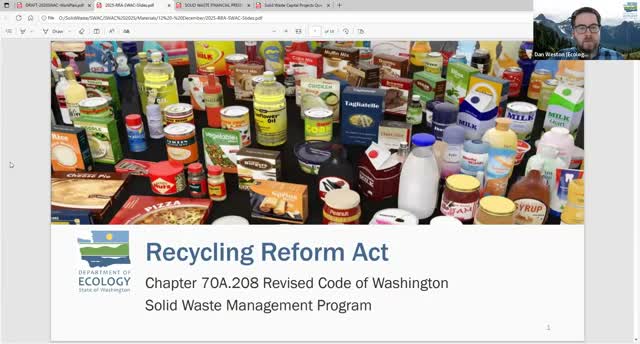
Summary
Dan Weston of Washington Ecology told the Thurston County Solid Waste Advisory Committee the Recycling Reform Act will require producers to fund residential recycling, create a statewide materials list, and require service-provider registration (deadline Jan. 30, 2026); Weston described reimbursement phases and invited public input on rulemaking.
Dan Weston, statewide recycling coordinator at the Washington Department of Ecology, gave a high-level briefing to the Thurston County Solid Waste Advisory Committee on the Recycling Reform Act and what counties and service providers should expect in the coming months.
“The program is focused on packaging and paper products that are sold to Washington consumers,” Weston said, describing the law’s scope and distinguishing it from business-to-business recycling. He told the committee the law establishes extended producer responsibility (EPR): producers will join or contract with a producer-responsibility organization (PRO) to fund residential and public-place recycling service and related startup costs.
Weston described a sequence of near-term tasks Ecology is leading: four studies (including a deposit-return modeling study), a statewide recycling materials list and two needs assessments. He said the first phase of one study was released for public review and that the statewide list is due Oct. 1 (with a preliminary needs assessment due Dec. 31). Weston advised that Ecology will open rulemaking early next year and that a CR-101 notice is likely in March or April.
On governance, Weston said producers will typically register with a PRO and service providers (including cities, counties, curbside haulers and MRFs) must register directly with Ecology. “Producers must join a producer responsibility organization or PRO and then pay annual fees that will fund most of the state's residential recycling system,” he said, and noted Circular Action Alliance has registered producers in other states.
Weston emphasized upcoming administrative deadlines and requirements. He said Ecology will open service-provider registration in early January and cautioned stakeholders that the online registration form is still under testing. “Any service provider that intends to seek reimbursement needs to register with Ecology by January 30, 2026,” he told the committee.
He also outlined expected reimbursement phases for eligible service-provider costs: “They'll receive at least 50% of their costs reimbursed in 2030, at least 75% reimbursed in 2031, and then 90% of their costs reimbursed in 2032 and after,” Weston said.
Committee members pressed on technical and economic details. Chad Sutter, who represents scrap-metal interests, asked whether scrap-metal processors would be swept into the program and whether producer fees would be passed through to ratepayers. Weston said the law contains an exemption for certain scrap-metal businesses (if they hold an applicable scrap-metal license) and offered to share the statutory language. On cost impacts he said studies from other jurisdictions and comparisons with Canadian and European EPR programs suggest the per-item cost is small; “it would be fractions of a penny, like, per item,” he said, while acknowledging producers may try to recoup costs.
Members also asked how material acceptance criteria will be set and how the PRO and Ecology will split responsibilities. Weston said Ecology will oversee rulemaking and approve the PRO’s program plan, while the PRO will propose implementation details in its plan and be accountable for meeting the performance standards Ecology requires. He described an “ecomodulation” approach in the law that charges producers different fees based on how recyclable, reusable or toxic their packaging is — an upstream incentive to change packaging choices.
Questions from municipal staff and residents focused on harmonizing county lists, contamination and whether new recyclers (for example, polypropylene processors) expanded capacity because of regulation or market opportunity. Weston said Ecology will run a needs assessment and gather public input to determine which materials are truly recyclable at scale and that the PRO and Ecology will use that evidence to set the statewide list and performance targets.
Weston closed by encouraging stakeholders to sign up for Ecology’s mailing list and participate in the advisory council and rulemaking process. He said Ecology expects to announce advisory council members soon and must establish the council by January 2026. He also offered to share webinar recordings and Q&A materials and to follow up with stakeholders on specific issues such as the scrap-metal exemption.
What’s next: Ecology will begin rulemaking and post registration and program-plan details over the next year; local service providers who want reimbursement should prepare to register with Ecology in January 2026 and plan to provide the data the needs assessment will request.