
High Point presents five‑year housing strategy aiming to preserve or produce about 5,000 units; funding and preservation highlighted
Get AI-powered insights, summaries, and transcripts
Subscribe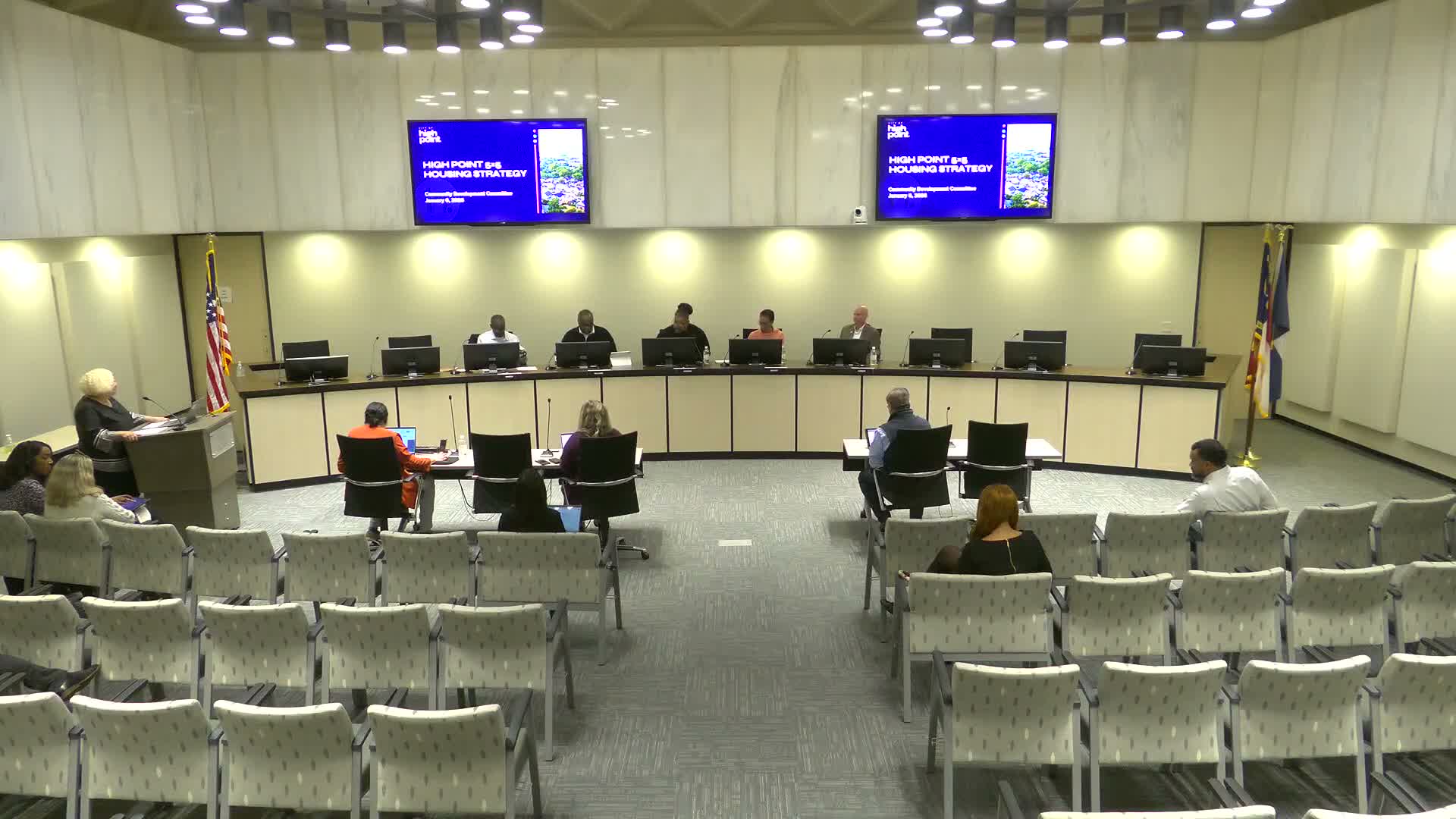
Summary
City staff presented a six‑pillar, five‑year housing strategy that targets roughly 5,000 units through preservation, production, workforce housing, homeownership and supportive housing, while flagging funding uncertainty and reliance on federal and partner resources.
City of High Point staff presented a five‑year housing strategy on Jan. 6 that sets a goal of preserving or producing approximately 5,000 housing units through public–private partnerships and federal, state and local funding.
Nina Wilson, the Community Development and Housing director, said the strategy is a six‑pillar framework that starts with preservation and rehabilitation and moves through production, attainable workforce housing, homeownership and wealth building, supportive housing for people experiencing homelessness, and systems, policy and funding alignment. "This plan will move High Point from planning to implementation, and it is aligned with the High Point 2045 comprehensive plan and the housing needs assessment," Wilson said.
Wilson warned the committee that Low‑Income Housing Tax Credit awards are competitive and that the city did not receive an award in 2025; she also said federal funding levels for upcoming years are uncertain. Staff described funding sources the city will leverage, including HOME (Home Investment Partnerships), Community Development Block Grant (CDBG) funds, American Rescue Plan funds and local dollars, and said staff will work with the finance director to identify local tools and return with recommendations in the coming 30–60 days.
The strategy included recent program performance and leverage examples: Community Housing Solutions’ projects produced 29 units with total development cost of $7,453,246, including $2,549,103 in HOME funds; Habitat had eight units in Southside with development costs of $1,230,042 and $243,921 in HOME funds. Wilson presented leverage ratios to illustrate the return on HOME investments.
Staff provided the strategy’s five‑year projection breakdown and a 2026 action plan: roughly 2,550 new units targeted for production, preservation of about 2,350 rental units, and preservation of about 200 ownership units for a 5,000‑unit five‑year goal. For 2026 specifically, staff projected preserving 150 at‑risk rental units, acquiring/rehabbing 75 naturally occurring affordable (NOA) rental units, 200 owner‑occupied rehab units in the core, 60 units assisted through foreclosure prevention efforts, and 50 units in supportive‑housing predevelopment, totaling 995 units projected for 2026.
During committee Q&A, Wilson defined NOA units as existing homes in older neighborhoods whose property values have remained relatively low and confirmed that the current ordinance allows accessory dwelling units (ADUs), with the Unified Development Ordinance (UDO) update providing an opportunity to streamline permitting and related site‑plan requirements. On deed restrictions and enforcement, a staff member explained deed restrictions would be recorded and, if violated, properties could revert to the city though the city does not proactively monitor every conveyance; title searchers and closing attorneys typically encounter deed restrictions during transactions.
Wilson emphasized the city does not expect to fully fund development itself and stressed partnerships and leveraging outside funds will be central to meeting the plan’s targets. There was no formal committee vote on the strategy; staff will continue to develop the action plan and budget estimates.
Next steps: staff will work with finance and planning staff to refine funding assumptions and geographic targeting and will return with action‑plan recommendations and budget estimates.