Get Full Government Meeting Transcripts, Videos, & Alerts Forever!
Get email alerts on the Land Use Rezoning topic
No spam. Unsubscribe anytime.
Kalamazoo commissionors receive training on rezoning, variance review and conflict rules
Summary
City planning staff and the city attorney briefed commissioners on how the Plan Commission and Zoning Board of Appeals handle rezoning, variances and public‑notice rules, and repeated guidance on avoiding ex parte communications and disclosing conflicts before quasi‑judicial hearings.
City planning staff gave Kalamazoo City commissioners a refresher on how rezoning and variance requests move through local boards, and the city attorney outlined legal limits on outside communications and conflicts of interest.
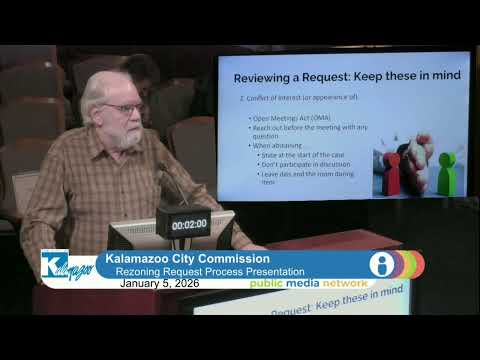
The training, presented at a Committee of the Whole meeting on Jan. 5, 2026, was led by Christina Anderson of the city’s Community Planning & Economic Development department, who described the roles of the Plan Commission and the Zoning Board of Appeals (ZBA), application and notice procedures, and the five review criteria used when a rezoning or text amendment comes before the city. Attorney Charlie Baer followed with guidance on ex parte contacts, disclosure and recusal.
Anderson told commissioners the Plan Commission handles map and text amendments, special‑use permits and some site‑plan reviews, while the ZBA reviews variance requests and appeals. She said staff seeks pre‑application meetings “so that when they’re submitting the application, they’re submitting a complete application” and noted state outreach rules require publication in the Gazette and mailed notice to property owners within 300 feet.
She walked commissioners through five criteria staff uses to evaluate rezoning and text‑amendment requests: consistency with the comprehensive/master plan and future land‑use map; change in conditions; demonstrable community need; compatibility with surrounding uses; and whether the change supports logical, orderly development patterns.
“The intent of a board reviewing these cases is to make a decision on the dais and not in advance,” Anderson said, explaining that staff reports aim to be neutral and lay out facts, outreach and how the review criteria apply.
Baer warned that boards acting in a quasi‑judicial role must consider only evidence presented at the public hearing. “You need to be objective. Your decision needs to be based on the facts and not subjective based on feelings or emotions,” he said, and advised commissioners to avoid one‑sided conversations with interested parties ahead of hearings.
Baer reviewed the city ethics policy and examples of potential conflicts—financial interests, familial ties, living within a notice area—and said any relevant interest should be disclosed on the record before deliberation. While he acknowledged the law does not always require a commissioner to leave the room, he recommended leaving the dais and the room when a conflict creates the appearance of bias.
The training concluded with no questions from commissioners. Mayor Anderson thanked the presenters and noted an upcoming rezoning hearing that prompted the refresher.
Next steps: staff will continue to use pre‑application meetings and staff reports to clarify outreach and criteria for forthcoming rezoning cases; the commission was reminded to direct parties to the public‑hearing process rather than engage in private communications.