Get Full Government Meeting Transcripts, Videos, & Alerts Forever!
Get email alerts on the Procurement Policy topic
No spam. Unsubscribe anytime.
Sunbury unveils first on‑call consultant list and outlines quality‑based selection process
Summary
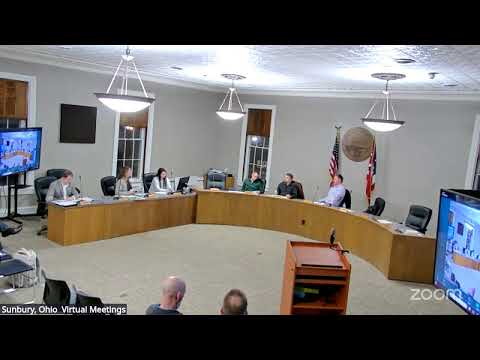
At the Jan. 7 Services Committee meeting, staff presented Sunbury’s first on‑call list of consultants and explained a quality‑based selection (QBS) process designed to prioritize qualifications and approach over lowest bid. The list includes 40 firms, will be updated quarterly, and preserves open solicitation for larger contracts.
Sunbury City staff presented the city’s first on‑call consultant list at the Services Committee information session on Jan. 7, describing a quality‑based selection (QBS) process that emphasizes firms’ qualifications and project approach over price in initial selection. Speaker 2 said the on‑call list grew from a statements‑of‑qualifications solicitation that ran from October through mid‑December and resulted in 40 consulting firms submitting materials.
The policy divides consultant work into 12 categories (roadway/multimodal, traffic and street lighting, sanitary and wastewater treatment, water distribution, stormwater management, plan review and general services, surveying/GIS, geotech and others). Speaker 2 said firms were asked to identify up to four categories to highlight and provide example projects and grant‑funding experience; only two firms submitted qualifications across all 12 categories.
Under the city’s stated procedure, projects with design or service contracts above $200,000 must proceed by open solicitation; projects between $75,000 and $200,000 may use the on‑call list by selecting three or more consultants to invite proposals. Speaker 2 said the selection workflow will include a blind review by three city reviewers, scoring according to published criteria, and a subsequent scope and fee negotiation with the preferred firm. "If at the end of the day, you can't agree on the pricing, it doesn't mean that you have to proceed," Speaker 4 added, describing a practice of moving to the next consultant if scope‑and‑fee negotiation fails.
Committee members pressed staff on safeguards against perceived favoritism. Speaker 3 asked how the city will avoid repeatedly choosing the same firms; Speaker 2 replied that reviewers’ scores and submitted proposals become public records kept by the finance director, and that debriefs are available to unsuccessful firms to explain scoring. "We keep them on file," Speaker 2 said, noting transparency is a feature of the policy.
Staff also described operational details: the on‑call list will be active in January, the first update is scheduled for Jan. 31, the city will accept quarterly additions, and after roughly 18 months the list will be refreshed and then maintained on a three‑year cycle. Speaker 2 said the QBS approach has been used for other regional efforts and is required for some federally funded projects (citing ODOT’s QBS process as an example of similar requirements).
The committee did not take formal action on the administrative policy during the information session; staff said the purchasing policy and any administrative rules still require final review by the council before new procurement rules are mandatory. The next procedural step is for council review of the purchasing policy language and any final adoption votes on administrative rules.