
First Meeting House in Hubbardston: safety upgrades complete, smoke-alarm sign-off and preservation restrictions remain
Get AI-powered insights, summaries, and transcripts
Subscribe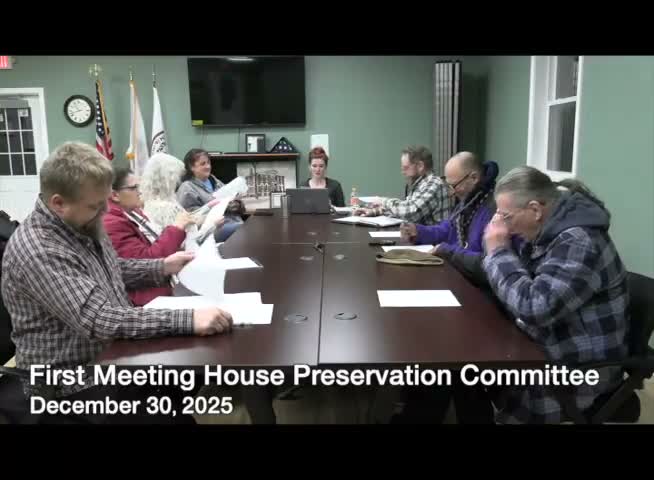
Summary
Town staff reported completed heating, plumbing, alarm and electrical work at the First Meeting House; final smoke-alarm inspection and review of preservation restrictions and ADA needs remain before the building can be fully reopened and used by outside groups. Members discussed clock/bell repairs and potential grant funding.
Town staff told the First Meeting House Preservation Committee that vendors have completed a series of safety and mechanical repairs but a final inspection remains before the historic building can be used broadly for public events.
Patricia Lowe said the town took over vendor accounts and safety monitoring after receiving the building: “National Grid has been turned over. Verizon has been canceled. Greenwood Alarms ... we turned the alarm system over to the same alarm system that we have for ... the DPW.” She added the alarm system is monitored and alerts go to Rutland dispatch.
Lowe said Peterson Oil inspected the burner and became the town’s oil delivery vendor; the pressure tank was replaced, crawl-space piping was replaced and insulated, and a new energy-efficient hot-water tank and two toilets and faucets were installed. Lowe said fire extinguishers were replaced and inspected and that bathroom lighting now uses motion sensors.
A final smoke-alarm inspection by the local official (Hayes) is still required before non-town entities may use the building; Lowe said Hayes will sign off once the inspection is complete. Until that sign-off the building remains closed to the public.
Committee members raised concerns about steeple, bell and clock conditions. Lowe reported the bell has a crack and the rope has been removed; she proposed forming small volunteer subcommittees for the bell and clock. The group recommended consulting local specialists; members cited a clock technician (Brian Tangway) in nearby Gardner/Templeton as a possible resource for repair and gear work.
Members discussed accessibility: contractors have provided initial assessments but a full ADA study may be needed and grant funding should be pursued. Lowe pointed to two recurring historical grant cycles that cover ADA and exterior/interior preservation work and encouraged the committee to review facility and ADA reports before applying.
The committee agreed to review the town’s preservation restriction and documentation from state and federal historic registers before undertaking substantive changes to the building’s fabric. Lowe offered to provide existing reports and to direct members to the Worcester Antiquarian Society and state/federal records for further research.
Next steps: the committee will review the facilities and ADA reports and preservation restriction before the next meeting and pursue small subcommittees for specialist tasks (bell/clock). The final smoke-alarm inspection remains the immediate gating item before broader public use.