
Planning commission hears opposition to proposed equine stocking limits
Get AI-powered insights, summaries, and transcripts
Subscribe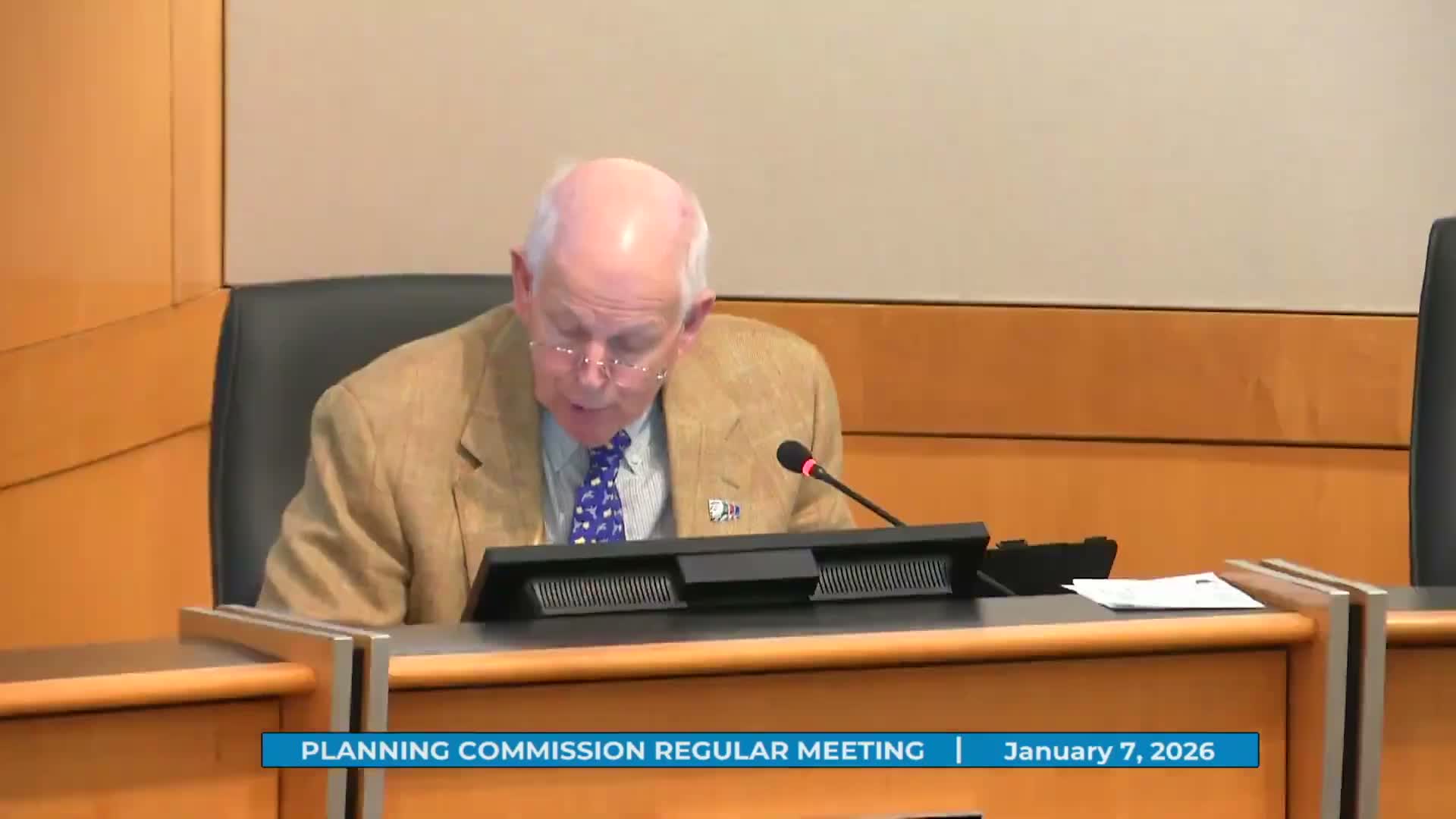
Summary
James City County planning commissioners heard extensive public comment opposing a proposed zoning amendment (Ordinance 25‑0005) that would lower allowed horse stocking rates and restrict manure storage in resource protection areas; commissioners agreed to seek more input and hold another public hearing rather than vote at this meeting.
At a planning commission meeting, commissioners considered Ordinance 25‑0005, a proposed amendment to the county zoning ordinance that would change how many horses are allowed per acre and restrict keeping manure in Resource Protection Areas (RPAs). Staff described a policy‑committee recommendation to adopt a lower stocking rate and a simplified approval process for noncommercial horse farms, including a proposed standard of 1.5 acres of usable land for the first horse.
Staff overview and proposal
An unnamed staff presenter told commissioners that, under current rules, the A‑1 zoning district limits horses to seven per acre and that the policy committee recommended lowering that rate and adding management requirements. The presenter said the draft includes a new stocking‑rate approach and a prohibition against storing manure in RPAs.
Public comments: management vs. numeric limits
Several residents and experts urged the commission to prioritize management and targeted water‑quality sampling over a countywide numerical limit. "The recommendation ... quote, ‘7 horses per acre is too high,’ end quote," said Nancy of Fire Tower Road, who argued the Colonial Soil and Water Conservation District’s 2019 assessment covered only a few watersheds and did not include water testing tied to the recommendation. She urged the commission to require data‑driven water sampling before adopting broad acreage limits.
Cheryl Matthews and another long‑time horse owner described on‑site manure management and regular supplementation of animals, saying many local owners already take steps to avoid erosion and contamination. "You cannot — in times of drought or times of too much wet — say that there is a one‑size‑fits‑all solution," one resident said.
Dr. Steve Esquivel, a semi‑retired equine veterinarian and member of a DCR technical committee, recommended focusing on management practices rather than strict stocking rates. He cited consultations with university experts and warned against separating equines from other livestock in policy. "[The equine industry] to the Commonwealth of Virginia provides $4,100,000,000 per year," Esquivel said, urging the commission to weigh industry impacts and to consider management‑oriented approaches such as manure plans and pasture maintenance.
Commissioner questions and next steps
Commissioners asked staff how proposed changes would affect nonconforming properties; staff said the draft does not include explicit grandfathering language but pointed to the ordinance's nonconformities provisions and noted rights can convey with property transfers. Commissioners agreed to solicit additional input from the horse community and the Colonial Soil and Water Conservation District and to continue work on the proposal.
The chair closed the public hearing and said the commission would hold another public hearing on the subject rather than approve the ordinance at this meeting.
What happens next
No final action was taken on Ordinance 25‑0005 at this meeting. Commissioners directed staff to seek further stakeholder input and to return the item for another public hearing after additional review.