
Probation fee waivers erode predictable revenue, county staff tell commissioners
Get AI-powered insights, summaries, and transcripts
Subscribe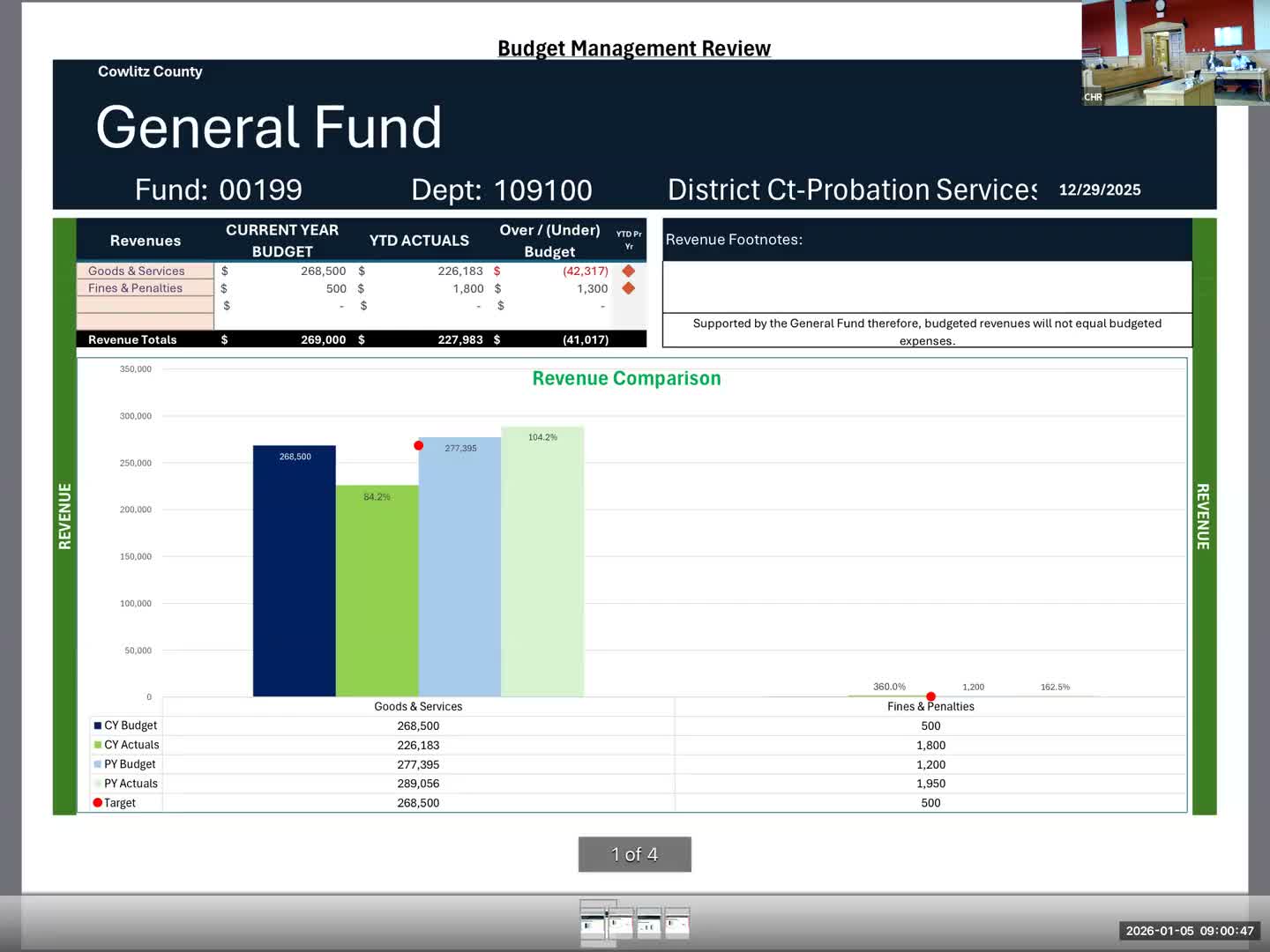
Summary
Cowlitz County staff told commissioners that an increasing trend of waiving probation fees under court indigency rules is making district-court revenue harder to predict, even as probation workloads remain steady.
County staff told commissioners at a Jan. 8 budget workshop that an uptick in requests to waive probation fees is reducing predictable revenue for district court probation services while officers continue to provide supervision.
The district court representative said judges and court rules increasingly require waivers of legal financial obligations, commonly called LFOs, when a person is deemed indigent, which limits the court’s ability to collect fees even though the county must still provide probation monitoring. “The attorneys are now asking to also have probation fees waived, and the judges are having to grant that on occasions,” the representative said.
Finance staff warned that the county cannot reliably budget those revenues. Commissioners were told that while traffic-infraction revenues depend on the volume of citations written by state patrol and tend to be paid, criminal-case revenues are unlikely to rise because of the waiver trend.
The discussion clarified that the authority to waive many court costs is set by supreme court rules and related state decisions, not by county policy. Board members said that uncertainty in fee collections makes multi-year forecasting and department budgeting more difficult.
Staff did not propose a specific policy change during the workshop; they said alternative approaches—such as revising billing practices with municipalities or continuing to seek more detailed revenue reporting—could be analyzed and brought back to the board.
The board asked staff to provide additional detail on collections and accruals and to return with figures to inform budget decisions later in the process.