Residents warn Geneva council against rushed dam removal, cite uncertain Army Corps findings and potential costs
Loading...
Summary
Multiple residents urged the council to pause plans for removing the Geneva dam, citing what they described as incomplete Army Corps (ACOE) studies, possible ecological damage, and municipal cost exposure; speakers asked the city to pursue local studies and more public engagement before acting.
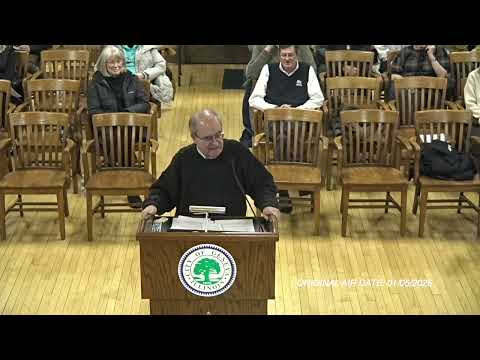
At the Jan. 5 public comment period several residents urged the Geneva City Council to delay or more thoroughly study any decision to remove the Geneva dam, citing ecological, safety and fiscal concerns.
Nancy Hayhurst presented extensive concerns about the dam process, stating Geneva’s website incorrectly claims the city has no control over the dam and asserting ‘‘We do have total control and here's why’’ because the Illinois Department of Natural Resources (IDNR) offered to transfer the dam to the city and the Army Corps of Engineers (ACOE) implementation is ‘‘only be done through partnership of the state, local, and federal levels.’’ Hayhurst also said research on small dam removals is limited and cited Carpentersville as a cautionary example, asserting that Carpentersville spent at least $4,500,000 on post‑removal repairs.
John Mazur focused on water quality, telling the council that the Geneva dam (built in 1960) functions as a reservoir that ‘‘allows physical, chemical, and biological processes to occur which cleans the water of contaminants’’ and argued ‘‘Removing the dam will make the water quality worse,’’ citing a published study in the Journal of Environmental Management.
City staff did not announce a council decision on the dam at this meeting. Speakers repeatedly requested more local meetings, expert reviews, and transparent documentation before any action is taken.
Why it matters: Dam removal can produce long‑term environmental and fiscal effects for riverfront communities. Residents pressed for included local experts, clearer roles among IDNR and ACOE, and careful study of downstream restoration costs and long‑term ecological outcomes.
What’s next: Speakers asked the council to ensure adequate public hearings and to consider local consultants or task forces; the council did not vote on dam policy at the meeting.