
Council debates amended salary ordinance as residents and departments press for a data‑driven wage review
Get AI-powered insights, summaries, and transcripts
Subscribe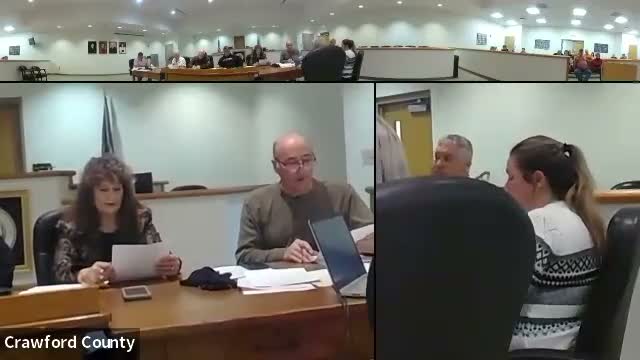
Summary
During the Jan. 6 meeting, the Crawford County Council introduced an amended 2026 salary ordinance and heard multiple public comments calling for a data‑driven review of wages; county representatives and the highway department warned of recruitment and retention challenges.
The Crawford County Council introduced an amended 2026 salary ordinance at its Jan. 6 reorganization meeting and heard extensive public comment urging a formal, data‑driven review of county wages and compensation.
Speaker 2 presented the amended salary ordinance and moved for adoption; the motion was seconded. During public comment, a prepared statement from Speaker 7 argued that many full‑time county positions fall at or below federal poverty thresholds and urged the council to publish specific benchmarks and carry out a data‑driven wage analysis comparing Crawford County to similar counties. Speaker 7 said, “Taxpayers deserve honesty, transparency, and reliable use of public funds,” and asked the council to commit to an analysis that would consider retention, cost avoidance and pay comparisons.
Representatives from the highway department (Speaker 5) reiterated that the county’s highway pay scales rank at the bottom of the five‑county comparison the department provided; they noted workforce age and imminent retirements — “50% of our employees are 60 years old or older” — and asked the council to consider targeted corrections to stabilize operations.
Speaker 6, speaking for a county office, described specific reimbursement streams that offset personnel costs, including PD/PD reimbursements and a 4‑d reimbursement formula. He urged the council to consider using available reimbursements to fund staff increases where legally and financially appropriate, saying that even a $42,000 raise for a specific staff position could be offset under current revenue flows.
The council did not adopt a final wage plan during the meeting. Speaker 2 said staff and the county attorney would review related funding and legal questions, and the council indicated it would revisit wage issues during budget deliberations, with a February review of advertised contracts and additional follow‑up requested.
What happens next: council members asked staff to review the public submissions and the handouts that accompanied the comments, and the county attorney was asked to clarify legal options for midyear raises and the use of specific reimbursement streams. No immediate budget appropriation for across‑the‑board raises was approved during the meeting.