
Commerce City launches citywide rezoning to implement 2025 Land Development Code
Get AI-powered insights, summaries, and transcripts
Subscribe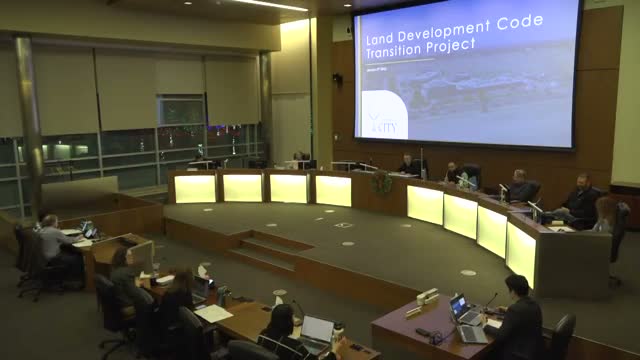
Summary
City staff told the Planning Commission they will pursue a roughly nine‑month legislative rezoning to apply the 2025 Land Development Code citywide, including targeted outreach and a Transit‑Oriented Communities process around the 72nd & Colorado station with a preliminary housing goal of about 1,700 units.
Commerce City on Tuesday launched a citywide legislative rezoning intended to put the newly adopted 2025 Land Development Code into effect across the entire city, staff told the Planning Commission.
City staff said the rezoning is a substantial, roughly nine‑month project designed to convert legacy zoning into the new code, align the zoning map with the adopted comprehensive plan, and create a single, citywide regulatory framework. "The first objective is 1 city, 1 code," Sung, the presentation lead, told commissioners, adding the process will use overlay tools to preserve Planned Unit Development (PUD) entitlements while assigning underlying base zoning.
Why it matters: the 2025 code will apply automatically only to new annexations and new zoning applications until the city performs a legislative rezoning. Staff said completing that rezoning will reduce reliance on the older 2009 code and create more consistent zoning across neighborhoods.
Staff outlined three major phases: Phase 1 will focus on the northern neighborhoods and the E‑470 corridor, with public engagement planned for March–April; Phase 2 will target the core city, Irondale and the Northern Business District in late May–July; and Phase 3 will compile a full draft zoning map for adoption in early third quarter. Sung said the city expects a draft map for Phase 1 in mid‑February and will present the material to City Council on Feb. 9.
The presentation included a discussion of the state Transit‑Oriented Communities (TOC) law (referred to in the presentation as "house bill 24 13 13"). Sung described two requirements in the law: establishing a housing opportunity goal for designated TOC areas (typically a half‑mile around stations) and applying zoning in those areas to accommodate the goal. For Commerce City, staff identified the TOC area around the 72nd & Colorado light‑rail station and presented a preliminary housing opportunity goal of roughly 1,700 dwelling units. "All the properties that are outlined in red contribute to that housing opportunity goal," Sung said during the presentation.
Staff also described categories of anticipated rezoning work: straightforward 1:1 conversions where the new base zones map directly to old zones; legacy zone reassignments where districts in the 2009 code no longer exist in 2025; alignment of PUDs using overlay districts; and policy‑driven rezonings to better match the comprehensive plan's character areas and economic development framework.
On PUDs, staff said the city will generally treat PUDs as an overlay so the PUD entitlement remains in place while staff assigns an underlying base zone. Sung and other staff said property owners would be able to apply to eliminate a PUD and take straight zoning instead, but that such requests would go through Planning Commission and City Council rather than being handled purely as an administrative action.
Next steps: staff plans a public outreach program that will include open houses and interactive online tools (including an interactive map) and will return to the Planning Commission for subsequent study sessions to review draft mapping recommendations and public feedback.
Provenance: presentation and discussion in the study session (topic introduction SEG 196 → topic finish SEG 651).