Get Full Government Meeting Transcripts, Videos, & Alerts Forever!
Get email alerts on the Stopping Stones topic
No spam. Unsubscribe anytime.
St. Mary’s County unveils 'stopping stones' at Leonardtown Jail to honor freedom seekers
Summary
At a chilly ceremony in Leonardtown, officials and community members unveiled five "stopping stones" honoring men jailed while seeking freedom; speakers recounted local slavery history, the 1864 Maryland constitution and the stones’ role as a site-specific remembrance.
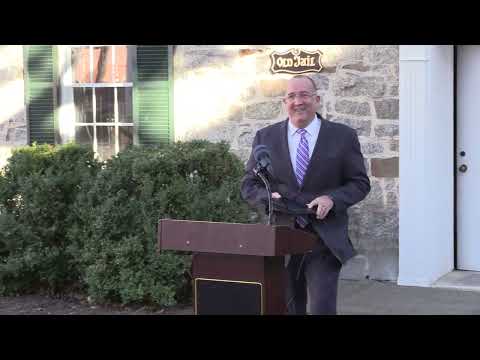
At a chilly outdoor ceremony in Leonardtown, St. Mary’s County, officials and community members unveiled five "stopping stones" honoring five men who were jailed while seeking freedom, organizers said.
The stones — granite bases topped with hand-stamped brass plaques — were provided to the county through a grant and were presented as tangible, place-based memorials to people held in the Leonardtown jail between 1858 and 1864. Nathaniel Lawrence, president of the Unified Committee for Afro American Contributions, described the initiative as "a historical and social reparation initiative created to recognize and remember the individuals enslaved in early America at this place." Lawrence said UCAC participated with other community partners to produce the stones.
Commissioner Eric Colvin, who identified himself as the vice president of the county commissioners, framed the event as part of Maryland Emancipation Day commemorations and said it was important the county remember both accomplishments and failures of its past. "As we gather together today for the celebration of equity and justice," Colvin said, "let us reflect on the significance of this day and continue to work towards a future where everyone... can enjoy the fruits of liberty and equality."
Magistrate Kevin Hill provided historical context, citing local and state milestones. Hill said the Maryland constitutional convention of 1864 produced a new state constitution that outlawed slavery and that, after a narrow statewide vote and counting of absentee soldier ballots, the constitution went into effect on 11/01/1864. He stated that, by 1860, roughly 43% of St. Mary’s County’s population were enslaved people and about 12% were free African Americans; he also noted that a Point Lookout prisoner-of-war camp in the county reached a reported population of about 15,000 by 1864.
Organizers explained that the five named men commemorated at the ceremony were identified through historical newspaper accounts that recorded arrests, escapes, and rewards. Readings by representatives of the St. Mary’s County Sheriff’s Department recounted those accounts, including notices about a man listed as Remus or George captured in March 1858; an August 1860 account of a man named Alonzo; an 1861 lodging notice for a man called George Scriber; a May 1862 notice about a man named John; and an account of Tom and Randolph Taylor charged and reported to have escaped jail in January 1864. Program staff said there were likely others held at the jail but these five are the ones documented in the local record.
Organizers said the stones were provided to the county free of charge as a grant and that each plaque lists the subject’s name and incarceration dates; the stones would be anchored in concrete after the ceremony and made available for public viewing. Father Bobian led prayers at the ceremony, citing John 8: "You will know the truth and the truth will set you free," and the event closed with musical and poetic performances.
The ceremony’s sponsors included the Unified Committee for Afro American Contributions and other community partners; attendees were encouraged to view the stones after they were permanently anchored. No policy actions or votes were taken at the event, which organizers described as a public commemoration and educational moment.