Get Full Government Meeting Transcripts, Videos, & Alerts Forever!
Get email alerts on the Road Closure Policy topic
No spam. Unsubscribe anytime.
Valley County begins drafting policy for emergency road closures amid avalanche risk around Warm Lake
Summary
At a county workshop, officials discussed a new, countywide emergency road-closure policy after Perpetua Resources’ operations and avalanche forecasts raised concerns; staff outlined statutory authority, enforcement gaps, signage and communication needs, and scheduled public input on Jan. 12 and an action item for Jan. 20.
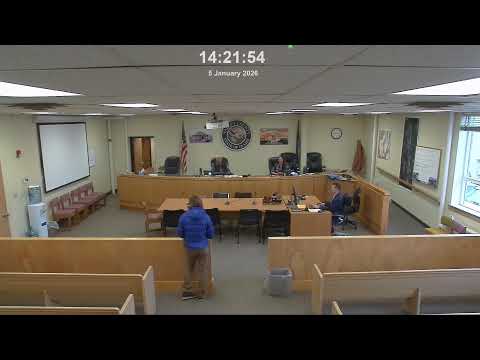
Valley County officials met in a workshop to begin crafting a countywide policy for emergency road closures after recent conversations about a proposed gate and avalanche risk near Warm Lake and Johnson Creek.
Speaker 2, who led the session and circulated a memo and statutes in advance, said the workshop’s purpose was “to have a more global conversation about emergency road closures,” including who would make closure decisions, what legal authority applies and how closures would be communicated and implemented. He pointed attendees to Title 40, Chapter 6 as the county commissioners’ statutory authority over public highways and to Title 31, Chapter 22 for the sheriff’s authority.
The discussion established two discrete policy steps the board must address: first, which roads (if any) the county will designate as restricted access; and second, the objective criteria or risk thresholds that will trigger either a restriction or a full closure. “So my goal in having this workshop conversation is, 1, how are you gonna designate roads? Which ones are you gonna designate? And 2, when it comes time to issue an emergency order, what's gonna be the basis for your decision?” Speaker 2 said.
Speakers agreed Perpetua Resources will perform on-site avalanche assessments and may physically place barricades or operate a gate, but the county’s formal order is needed to make any closure enforceable. “Perpetua is going to implement a road closure, but they'll be looking to the county to make that decision to close the road,” Speaker 2 said. That sequence — private assessment/operational closure versus the county’s legal order — was a recurring point.
Enforcement and penalties were flagged as priorities. Speaker 2 noted a conflict between Valley County code and state statute: the county ordinance currently treats winter wheel-traffic closures as an infraction, while the state statute identifies violations as a misdemeanor. “I think you need to take a closer look at that,” Speaker 2 said, urging the ordinance be clarified so law enforcement has appropriate authority. Speaking for the sheriff’s office, Speaker 4 argued for misdemeanor-level penalties to give deputies enforcement tools beyond issuing citations: “If it's an infraction, you're tying our hands… we have to have some sort of teeth.”
Practicalities dominated much of the conversation: whether to install a physical gate or rely on temporary barricades and clearer signage; how double-gating (top and bottom gates) might help prevent motorists from becoming stranded; how to retrieve vehicles left behind after a closure; and whether contractors should retain limited access when the public is restricted. Several staffers said a purchased permanent gate would not be in place this season and recommended temporary barricades and clearer electronic reader-board messaging in the near term.
Speakers emphasized the need for an explicit communication protocol tied to any policy so that closure messages — and the differences between a restriction and a full closure — are clear to visitors and residents. Speaker 5 described existing permit-based temporary signage and a reader board at the way station intended to display changing road conditions; several participants said that reader board had not been reliably updating.
The board did not adopt a policy at the workshop but set next steps: a public workshop with Perpetua Resources and an opportunity for public testimony on Jan. 12, and an action-item hearing on a road mitigation agreement (RMA) with Perpetua scheduled for Jan. 20 at 1:30 p.m. Staff were directed to return with refined options for a short-notice closure protocol, suggested risk thresholds tied to avalanche forecasts, proposed enforcement language to resolve the misdemeanor/infraction discrepancy, and recommended signage/communications language.
The county’s focus going forward is to balance public safety and first-responder capacity with operational needs and to produce clear, written policy (and, if required later, ordinance language) that defines when and how roads will be restricted or closed.
Ending: The workshop prepared the board for more detailed hearings next week; commissioners will hear Perpetua and public testimony on Jan. 12 and may act on the mitigation agreement on Jan. 20.