Get Full Government Meeting Transcripts, Videos, & Alerts Forever!
Get email alerts on the Transportation topic
No spam. Unsubscribe anytime.
Planning Commission recommends council adopt modernized parking ordinance, waiving nonresidential parking for most small businesses
Summary
The commission voted to forward a comprehensive parking code update to the City Council that largely eliminates nonresidential parking requirements for uses up to 5,000 sq ft, applies a 3‑spaces-per-1,000‑sq‑ft standard for larger expansions, and updates multifamily and shared‑parking rules.
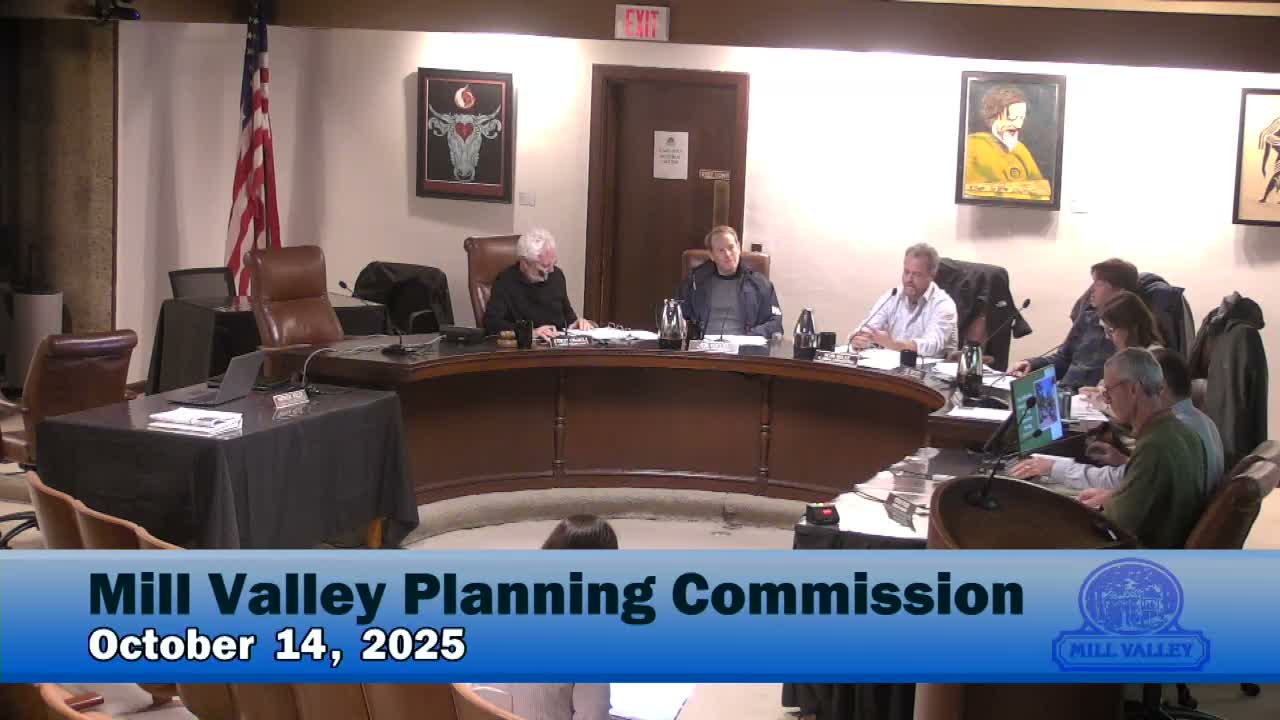
The Mill Valley Planning Commission voted to recommend the City Council adopt a new parking ordinance (chapter 20.61) that modernizes parking ratios, design standards and shared‑parking rules across the city.
Patrick Kelly, director of planning and building, summarized the package as the outcome of a Walker Consultants study: the council supported eliminating nonresidential parking requirements for buildings and changes of use up to 5,000 square feet and applying a blended 3 spaces per 1,000 square feet ratio for expansions over that threshold. Kelly said the code also adopts multifamily standards "1 space per unit for units less than 1,000 square feet, and then 1 guest space per 10 units," allows tandem/stacked and uncovered spaces in all districts, and increases the shared‑parking reduction cap from 10% to 40%.
Kelly said the change to a standalone chapter 20.61 will ripple through the zoning code, updating dimensional and loading standards and codifying a process for peer review of shared‑parking studies. He said the council directed that parking management be handled separately from the ordinance and pointed to recent council actions to modernize meter technology.
Commissioners raised questions about residential parking management and how the ordinance treats certain downtown scenarios; staff and Walker consultants reported private lots on Miller were underutilized during peak times and that the blended ratios are based on local demand counts. During public comment, architect Michael Heacock said he was "thrilled about this" and called the update "a tremendous improvement."
After deliberation—during which several commissioners said the package "nudges" the city toward fewer parking requirements and greater walkability—the commission moved, seconded and voted to adopt a resolution recommending City Council approval. The council is scheduled to consider the ordinance in November per staff remarks.
Next steps: the commission’s recommendation will be transmitted to the City Council for final action.