Get Full Government Meeting Transcripts, Videos, & Alerts Forever!
Get email alerts on the Affordable Housing topic
No spam. Unsubscribe anytime.
Mill Valley planning panel recommends council reapprove 45-unit Hamilton Drive affordable housing project amid CEQA dispute
Summary
After public hearings focused on traffic, tree loss and a narrow wetland boundary change, the Mill Valley Planning Commission unanimously recommended City Council reaffirm rezoning and reapprove design and tree removal permits for a revised 45-unit affordable housing project at 1 Hamilton Drive.
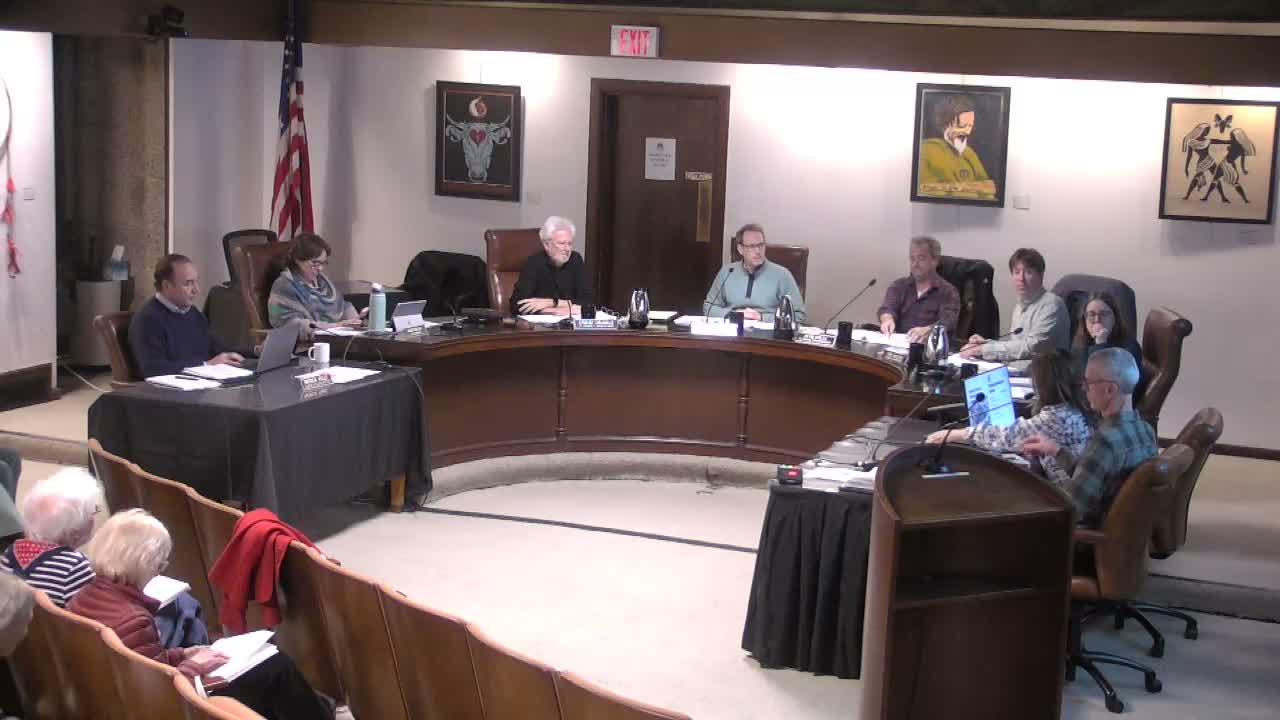
The Mill Valley Planning Commission unanimously recommended the City Council reapprove rezoning and design permits for a revised 45‑unit affordable housing project at 1 Hamilton Drive on Nov. 17.
Staff and the project team told commissioners the parcel has a long approval history dating to about 2000 and that the revised plan trims the housing parcel from about 1.75 acres to roughly 1.6 acres by removing approximately 0.15 acres (about 0.011 acres, cited in staff materials) that contained a seasonal wetland. Principal Planner Danielle Staudy said the building footprint, colors and materials are unchanged and that the project remains a podium‑parking design with 63 garage spaces, 44 affordable units plus one manager unit (described in materials as 45 units total), and that mitigation measures from the prior environmental impact report will be adopted as conditions of approval.
Opponents at the hearing raised concerns about noticing, timing and process, asserting the boundary adjustment is intended to fit the project into a new state CEQA exemption and to avoid judicial review while litigation is pending. Resident Geralyn Sealing told the commission, “This is clearly an effort to adjust a boundary to retroactively squeeze the project into a new CEQA exemption,” and asked commissioners to delay action so the neighborhood can review materials in plain English. Several speakers, including Paula McGrath and others who use nearby Hockey Park, emphasized weekend parking shortages and traffic safety around Hamilton Drive and Kipling, saying the area can be congested during games and that current parking and circulation may not accommodate future residents and park users.
Residents also asked technical questions about environmental compliance. Resident Kevin McGrath asked whether the Phase I environmental assessment cited in the resolution (performed in February 2022) satisfies the statutory standard in the health and safety code because, he said, the cited code provision became effective in 2023: “Are we relying on that 2022 assessment? Or is there going to be a new one?” staff documents note that a Phase I is required in conditions of approval.
Staff and several commissioners defended the item as a limited, non‑material change that triggers a categorical exemption under AB 130, a recently adopted state law intended to expedite infill affordable housing where prior EIRs exist and no new significant impacts are identified. Staudy told the commission the AB 130 exemption helps address a pending lawsuit affecting the project and removes a funding barrier. Commissioners who spoke urged balancing neighborhood concerns with state housing mandates and the practical need to secure tax credits and financing; one commissioner said the sponsor is not seeking an additional density bonus and is keeping the 45‑unit project as presented.
City Attorney Inder Khalsa read two resolutions for the commission’s vote: one recommending that the City Council reaffirm rezoning of the northern portion of 1 Hamilton Drive (APN 03025001) from Open Area (OA) to Residential Multifamily Bayfront (RMB) and update the zoning map, and a second recommending reapproval of the design review and tree removal permits for the affordable housing project including the Public Safety Building site modifications. Commissioner Yolos moved to approve “as read,” seconded by Commissioner Schuyles; Commissioners Kasparick, Macris, Schuyles, Yolos and Serango each answered “Aye,” and the commission’s recommendation passed unanimously.
The commission’s action is a recommendation to City Council, which staff said is expected to act in 2026. Chair Ernest Sarangel announced that planning commission decisions may be appealed to the City Council within 10 calendar days accompanied by a $1,057 appeal fee; the city attorney clarified the commission’s recommendation will automatically proceed to council without requiring an appeal.
Next steps described by staff include council action in 2026, financing and then construction if approvals and funding proceed. The record for the commission’s recommendation includes Exhibit A (findings) and Exhibit B (conditions of approval) with redlined tribal consultation items and a note that previously adopted EIR mitigation measures will be carried forward.