Get Full Government Meeting Transcripts, Videos, & Alerts Forever!
Get email alerts on the Identity Management topic
No spam. Unsubscribe anytime.
California data exchange stakeholders refine identity-management problem, debate centralized IDs vs. federated search
Summary
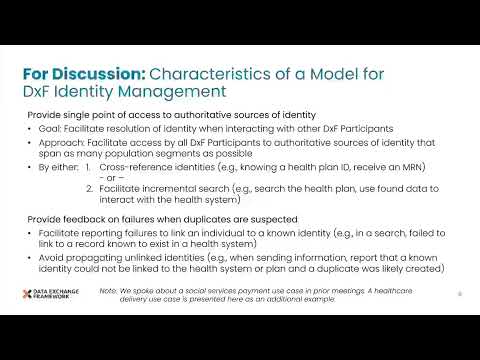
Stakeholders in California's data-exchange (DXF) series refined a problem statement and debated two core approaches to identity management: a centralized authoritative identifier layer versus a federated search plus duplicate-reporting workflow, while flagging equity and workflow concerns for people without official IDs.
Rym Cothren, the meeting facilitator, opened the final session in a state identity-management series and said the goal was to refine the problem statement and identify characteristics of a solution rather than design a final technical architecture. "We are not gonna end today's meeting with a full blown technical architecture for identity management statewide," she said, framing the discussion around practical tradeoffs the group must resolve.
The central issue identified by participants was that person-matching across health care, social services and public health systems is "unreliable and inaccurate," producing duplicates and gaps in service. Meeting participants coalesced around two high-level solution components: (1) facilitating access to authoritative sources of identifiers (for example, DMV records or Medi-Cal benefit numbers) and (2) a feedback mechanism to report and resolve suspected duplicate identities so mismatches are not propagated.
Speakers divided on whether DXF (the data exchange framework under discussion) should build a central authoritative identity layer or instead provide a federated "search" capability that queries existing authoritative systems. Jeff argued that a federated search will be inconsistent and slow and that "DXF would need to be an authoritative central identity layer, like an EMPI or MDM solution" to provide a single source of truth and performant, reliable lookups. Aaron and others warned that introducing human decision steps in the middle of searches could undermine near-real-time exchange.
Opposing that view, participants including Rym and several panelists noted practical and equity concerns. Julie raised that many people—especially those experiencing homelessness—may lack authoritative identity documents and warned that strict requirements risk excluding people from services: "we're gonna get the person food even if we can't confirm that this person is the person," she said, arguing that the system must allow lower-confidence matches where the risk of denying care outweighs the risk of incorrect linking.
Several participants emphasized the need to surface match certainty (identity-assurance or confidence levels) for downstream users and to tailor verification requirements to the service or program. Lloyd described a continuum of assurance levels (IAL2/IAL3) and urged risk-based handling: low-confidence matches could be accepted for lower-risk interactions while higher-confidence verification would be required for higher-risk uses.
Operational experience from enrollment and exchange practitioners reinforced both points. Eric described how agents without search tools create duplicate records at intake; enabling limited-information searches could reduce duplicates and improve continuity of care. Ken cautioned that technology alone will not solve the problem: workflows, reconciliation processes, and human factors learned in QHIO/HIE operations are essential to any sustainable approach.
Participants also discussed intermediary options. Chris suggested that QHIOs or other intermediaries that already combine authoritative organizations' data might perform trusted identity-matching services, potentially avoiding the need for a single new central layer for all participants. Questions remained about how to communicate suspected duplicates across systems and how to un-link records if duplicates are later confirmed.
No formal action or vote occurred. Rym closed by summarizing the session's outcomes: a clearer problem statement, agreement on key solution characteristics to explore further (authoritative-source access, a duplicate-reporting workflow, match-certainty metadata, and purpose-of-search communication), and a plan to carry these characteristics into the next steps of DXF work.
What happens next: the group will use the refined problem statement and the identified characteristics to inform subsequent design work and stakeholder outreach; the meeting recorded no formal decisions or binding technical commitments.