Get Full Government Meeting Transcripts, Videos, & Alerts Forever!
Get email alerts on the Parking Regulation topic
No spam. Unsubscribe anytime.
San Fernando adopts ordinance to regulate RV parking, prohibit vehicle habitation on public streets
Summary
After a public hearing and staff presentation, the council adopted an ordinance that creates a limited residential/guest RV permit (2 consecutive nights; extensions up to 4 days/month), bans vehicle habitation and hookups on rights-of-way, and gives the police chief discretion to deny permits that would create a traffic hazard.
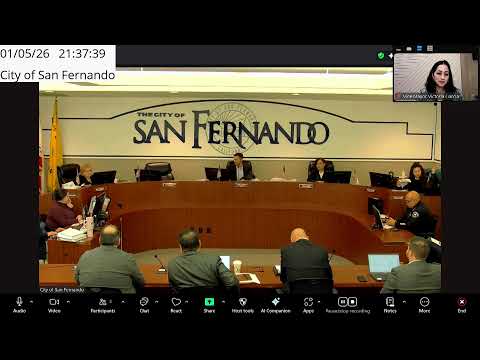
San Fernando — The City Council on Jan. 6 approved an ordinance amending Chapter 90 of the San Fernando Municipal Code to tighten rules on recreational-vehicle parking and to prohibit sleeping in vehicles on public streets.
Police officials presented the measure as a response to neighborhood safety and quality-of-life complaints. Sergeant Walter Dominguez said the ordinance establishes a residential and guest RV permit system that allows a maximum two consecutive overnight days per permit, expiring at 6 a.m. on the third day, with a possible extension to four calendar days per address each month. Permit holders must be city residents, park on the same block as their address and not within 50 feet of intersections. The ordinance also bars running cords or hoses across sidewalks and streets, dumping waste, connecting to sewers, using slide-outs that block travel paths or using external power sources.
Mayor Joel Fajardo and members of the council debated safeguards for narrow residential streets. City Attorney Padilla and staff drafted language that gives the chief of police discretion to deny a permit if, in consultation with the public-works director, the vehicle would create a traffic hazard or otherwise impede the free flow of traffic. The council approved the ordinance with the attorney’s deletion of a single word in the definition of habitation and the added traffic-hazard discretion; the final vote was unanimous.
Chief Fabian Valdez emphasized an education-first approach: before citation-based enforcement begins the city will run a 30-day outreach and education effort so residents understand the new rules. He said the goal is compliance through outreach, with enforcement tools available for repeat noncompliance.
Council members also discussed partnerships with nonprofit service providers for unhoused residents who are living in vehicles. Sergeant Dominguez said the police department would refer people to regional providers but acknowledged a high rate of refusal for offered services. Staff said permits and any future fee schedule would be administered within existing departmental resources and that any proposed fees would return to council for approval.
The ordinance modifies local enforcement policy but includes provisions designed to allow limited, temporary use (for example, short-term vehicle preparation or guest camping) while preventing long-term street storage and addressing safety concerns on narrow streets. The City Council will consider administrative procedures, including any permit fees, at a later date.