
Delaware County Board holds 2026 organizational meeting; elects officers and approves routine resolutions
Get AI-powered insights, summaries, and transcripts
Subscribe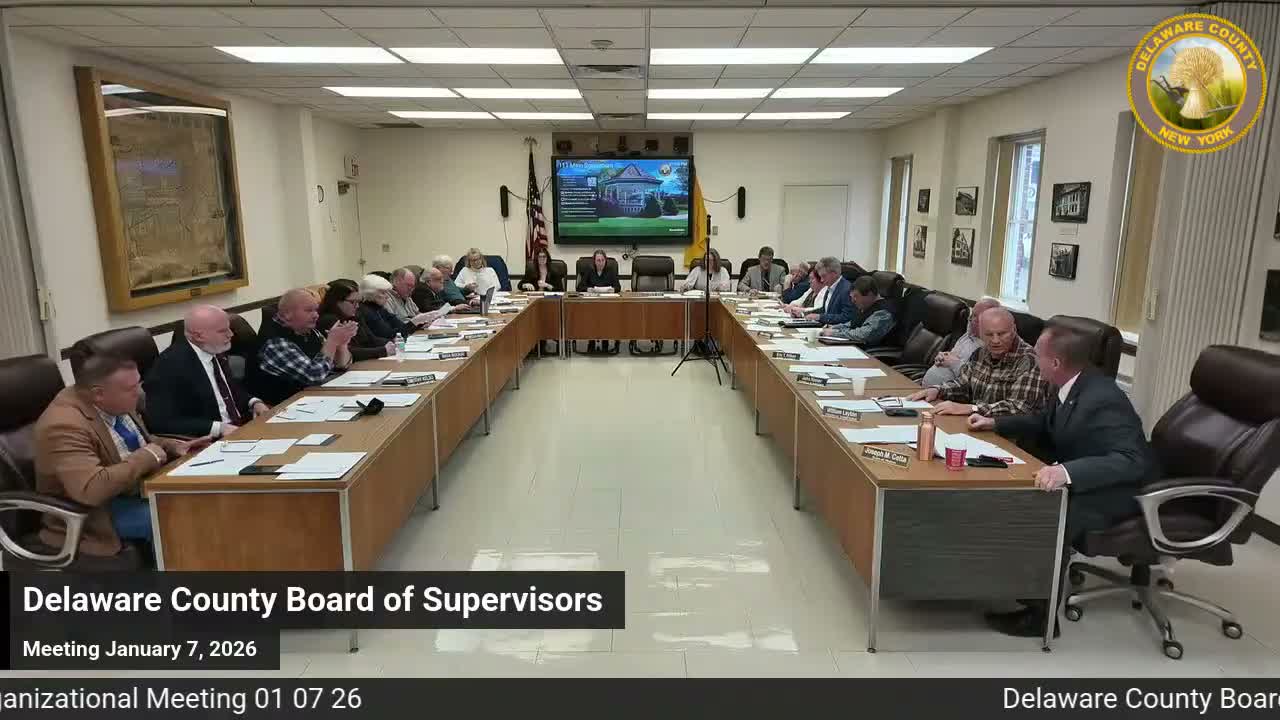
Summary
At its organizational meeting the Delaware County Board of Supervisors elected officers, swore in leadership, approved a slate of appointments across county boards and committees, and adopted a series of routine budget amendments and memorial resolutions. An objection was raised over the county newspaper designation.
The Delaware County Board of Supervisors met for its 2026 organizational session to elect leadership, confirm appointments and adopt routine resolutions. Supervisors nominated and moved to elect a chair and vice chair, appointed clerks and officers, and approved multiple budget amendments and memorial resolutions.
During the roll call and nomination period, a supervisor nominated Gina Bolle for chair and James Ellis for vice chair; Penny Bishop was nominated for clerk of the board and Arthur Merrill was nominated for budget officer. The county clerk (named in the transcript as Haley Grant) administered the oath of office to the incoming chair and other officers. Several board members also moved to reappoint agency and advisory-board members, including reappointments to the Delaware County Industrial Development Agency, local development corporation, planning board, health services advisory board, soil and water conservation district, tourism advisory board and youth bureau.
The chair delivered extended remarks thanking staff, welcoming new county officials and describing a recently signed intergovernmental agreement with New York City aimed at limiting large parcel acquisitions in the county and providing program funding to mitigate watershed impacts. The chair also summarized a range of 2025 state laws and initiatives that the board says could require additional county staff time and funding, including: county EMS planning requirements, corrections oversight changes, expanded property tax exemptions for qualifying seniors, election registration changes and provisions addressing cybersecurity and child-care supports. The chair said these state actions could increase workload for county departments and emphasized the board’s intent to pursue state and federal support rather than raising the local tax levy.
Board business included designation of the official newspapers for county legal notices under county law; one supervisor objected to the choice and argued that the Recorder should be included because of its coverage. The board voted on a series of numbered resolutions (Nos. 1–17 in the transcript). Measures included routine reappointments (e.g., elections commissioner, community mental health director, economic development and youth bureau directors), designation of financial depositories, payment authorizations for public works rentals, disposition of surplus property, several budget amendment transfers for 2025 and 2026 (including county sheriff’s office items), and memorial resolutions honoring two recently deceased local officials. Most measures were carried by roll call or voice vote as recorded in the meeting.
On a budget amendment item related to school resource officers, supervisors confirmed the funding source as two school districts that deploy those officers; the amendment was characterized in the meeting as an "overage" rather than a baseline revenue item and thus required a budget amendment for 2025. Several supervisors asked clarifying questions about whether similar items would be in the 2026 proposed budget.
The meeting produced a slate of appointments with specific term end dates noted in the record (for example, four-year terms ending 12/31/2029 for certain community services board appointments and a number of three-year terms ending 12/31/2028 for other boards). The board also approved memorial resolutions for George Burke Leitner and James E. Eisel Sr. and agreed to send copies to their families. With routine business concluded, the board adjourned and scheduled its next meeting for the end of the month.
Votes at a glance: the transcript records adoption of Resolutions Nos. 1–17 (each moved and seconded during the meeting); many were carried by roll call with individual "yes" votes recorded in sequence and several were approved by voice vote. When members asked for clarifications or raised objections (for example, over newspaper designation), those points were discussed on the record before the vote.
Procedural note: the meeting transcript contains some transcription inconsistencies in personal names and a few place names. The article limits attributions and uses only names explicitly stated in the transcript when identifying nominees or appointees.