
HCAI proposes technical clarifications to 2026 data submission guide for APMs and primary care reporting
Get AI-powered insights, summaries, and transcripts
Subscribe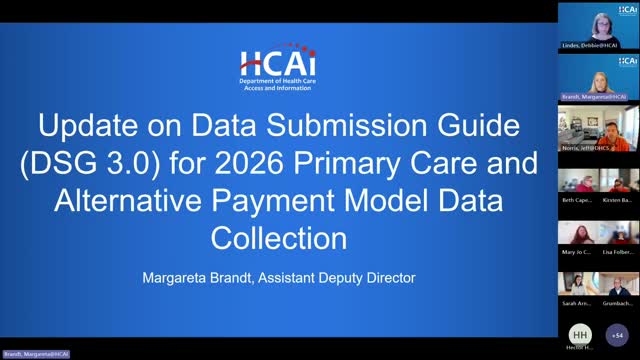
Summary
At a HCAI work group meeting, staff previewed the 2026 Data Submission Guide (DSG 3), saying changes are mainly technical clarifications for alternative payment model (APM) and primary care files and that managed-care reporting will align with DHCS guidance; public comment will open in January.
HCAI staff told the agency's investment and payment work group that the 2026 Data Submission Guide (DSG 3) will include technical and format clarifications for alternative payment model and primary care data submissions, while keeping the underlying measurement methodologies unchanged.
"There are no changes to the methodology," said Margaretta Brandt, assistant deputy director for health system performance. "These are really intended to be clarifications to further explain [the methodology] and address questions we received." Brandt said the guide is the third version of the DSG and contains the formal instructions for submitters about definitions and configuration for 2026 reporting.
Key drafting changes previewed include new guidance on attributing member months in the APM file, a process map to illustrate how member expenses are reported, and clarified methodology for claims and non-claims primary care payments. HCAI plans to add physician assistant (general) to the primary care provider definition and to include recently issued CMS advanced primary care management service codes in the primary care code set.
Brandt also said HCAI worked with the Department of Health Care Services (DHCS) to clarify which DHCS payments medical managed-care plans should include or exclude when measuring primary care and APM spending. She gave examples: pass-through payments will be excluded from primary care calculations, while vaccine-administration fees from the Vaccines for Children program will be included. For claims-based determinations of whether a provider is a primary care provider, managed-care plans will be instructed to use the monthly 274/annual network certification file submitted to DHCS, analogous to commercial plans using Department of Managed Health Care network files.
Work group members asked technical and policy questions. Yagnesh raised whether APM data could be filtered by patient severity to discourage "cherry-picking" of lower-complexity members; Brandt said HCAI does not currently differentiate by severity in the APM collection but could consider the suggestion. Several participants asked how membership-based APM categorization interacts with quality links; staff and consultants explained that HCAI tracks both membership in payment arrangements and spending subcategories to provide context on plan payment structures.
HCAI plans to release DSG 3 for public comment in January and to publish the final guide in the spring in advance of 2026 data submissions in September. The agency invited work group members and other stakeholders to review and submit comments during the public-comment period.
Next steps: HCAI will post the draft DSG for public comment and provide guidance materials to data submitters; staff offered to follow up individually with plan representatives who requested deeper methodological walkthroughs.