
Snoqualmie committee reviews December flood costs, discusses ratifying mayor's emergency proclamation
Get AI-powered insights, summaries, and transcripts
Subscribe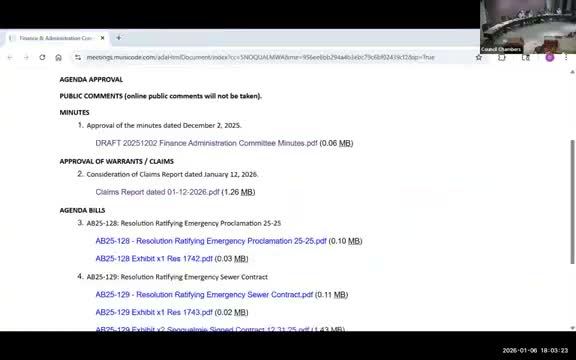
Summary
The Finance & Administration Committee discussed a resolution to ratify the mayor's December emergency proclamation, heard staff estimates of roughly $320,000 (direct) to $520,000 (including repairs) in city costs from the storm, and outlined steps and deadlines for state and federal reimbursement.
The City of Snoqualmie's Finance & Administration Committee on Jan. 12 reviewed a resolution to ratify the mayor's emergency proclamation tied to a Dec. atmospheric river and received a staff briefing on the city's estimated costs and the path to seek state and federal reimbursement.
City Attorney Dina Burke told the committee the ratification is a code-driven step that confirms the mayor's action and aligns council oversight with state requirements. "Snoqualmie Municipal Code section 2.48.005 requires that as soon as practical, following a proclamation of emergency, that it be approved and ratified by the city council," Burke said, adding the ratification also supports the checks and balances around emergency contracting.
Why it matters: ratification helps preserve the administrative record and clarifies the council's role as the city seeks reimbursement for response and recovery costs. Staff said ratifying the proclamation does not, by itself, create new spending but formally recognizes the emergency period that enabled expedited contracting.
Public works staff member Drew presented the city's preliminary accounting of the event and the next steps to request a presidential major disaster declaration. Drew said the city currently estimates about $320,000 in direct impacts so far, including roughly $113,000 in employee costs, $26,000 in supplies and $52,000 in services. He said additional repairs — including fiber-optic work, a sewer repair contract and responses to three sinkholes — bring the city's estimated tab to about $520,000 to date. "We are currently estimating that to date, the impact of the December is roughly $320,000 in total that the city has spent," he said.
Drew outlined the administrative pathway to federal aid: the governor must request a major disaster declaration after the state demonstrates it has exhausted its resources. The city must compile preliminary damage assessments, photographs and separate accounting for response versus recovery costs and submit that material to county and state officials. Staff set a target of Jan. 20 to deliver completed materials to the state and named a city point person to lead the effort.
The committee also discussed support available to residents. Drew said individual assistance is a separate FEMA-administered process and requires residents or businesses to file with King County; he noted that deadline (for an initial filing) was Dec. 28 and had already passed for immediate eligibility in that program.
On infrastructure, the committee heard that fiber-optic service was restored with a temporary fix tying both fibers to a single active line while poles are replaced. Staff said permanent undergrounding is being considered but will be costly and require coordination with partners such as the school district given sensitive creek and right-of-way areas.
Next steps: staff will return in about two weeks with more detail on how the city will budget for the estimated costs and with materials for the state's damage assessment. The committee agreed to review the ratification resolution as part of the Finance & Administration agenda rather than placing it on consent.
No final vote on the ratification resolution was recorded during the committee meeting; procedural and scheduling actions taken at the meeting included removing a separate sewer-contract agenda item and approving minutes and claims to move forward to the full council.