
Kane County committee advances short-term rental licensing, sends ordinance off consent after heated debate
Get AI-powered insights, summaries, and transcripts
Subscribe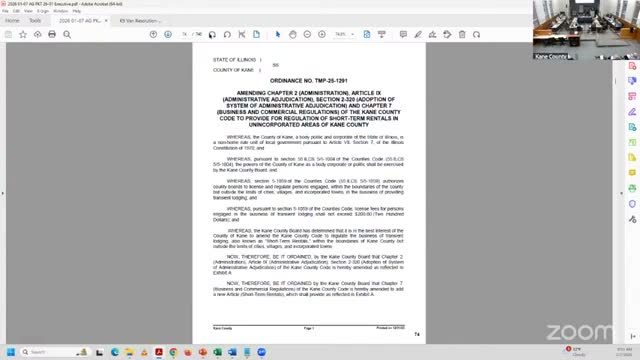
Summary
After extensive public comment and hours of discussion, the development committee voted to send a package of short-term rental rules — licensing, occupancy caps, noise and trespass tools — off the consent agenda to the full Kane County Board for two readings.
The Kane County Development Committee voted Jan. 6 to forward a new short-term rental ordinance to the full county board, sending the measure off the consent agenda for fuller consideration after extended public comment and debate.
The ordinance (TMP 25-1291) would require anyone renting a property for fewer than 30 days in unincorporated Kane County to apply for a county license, pass inspection, pay a fee and comply with new operating rules. Sponsor Rick Williams said the proposal is intended to create a mechanism to identify who is operating short-term rentals and to provide enforcement tools for problem properties.
"If an applicant is not following the terms of this ordinance, then we have a pretty severe mechanism to impose fines or revoke their license," Williams said, describing license, inspection and revocation authority in the draft.
The committee clarified several specifics: occupancy will be calculated as two people per bedroom, but the ordinance caps guest totals at 16 regardless of bedroom count; owners will not be required to occupy the property; and the county will rely on complaint-driven enforcement with the sheriff’s office and code enforcement following up on reported violations.
Several residents urged caution. Deanna Davidson, who said she lives next door to an STR, asked the committee "not to forward this ordinance onto the board for full review," arguing the draft would codify a broad permission for transient lodging in residential neighborhoods and could limit future legal options.
Board members debated fees and legal authority. Committee members said the draft sets an initial fee of $200 with a $100 renewal, but legal staff cautioned that fee authority may be constrained by statute and that broader tools such as a hotel-occupancy tax would require state or legislative action. "If it's not available, then I believe the 200/100 is the maximum that would be allowed," the county attorney advised.
Supporters argued the licensing system would reduce repeated party-house calls and provide contact information to enforcement officials. Opponents warned about grandfathering (existing operators likely would be allowed to continue) and that the county lacks staff capacity to proactively police all rentals.
The committee amended the sponsor’s motion to send the ordinance to the county board off the consent agenda so it would not be eligible for approval without fuller discussion; that procedural motion passed on roll call. The ordinance will now appear on the county board agenda for formal consideration and the statutory process described by staff (two readings and public notice).
Next steps: the full county board will receive the ordinance and related companion items (noise, nuisance/trespass changes) for formal action.