Get Full Government Meeting Transcripts, Videos, & Alerts Forever!
Get email alerts on the Philo Road Study topic
No spam. Unsubscribe anytime.
Urbana staff previews Philo Road corridor study, student studio and housing needs assessment
Summary
City staff presented student studio work and next steps for a small‑area plan for Philo Road, summarized outreach including a Sept. 7 “Philo Road Ahead” event, and said a housing needs assessment procured from RPC is underway with expected delivery in early 2026.
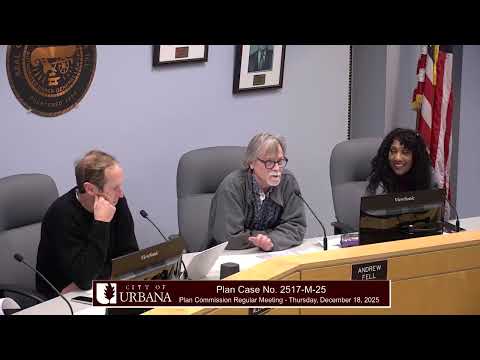
Urbana planning staff on Thursday gave commissioners a study‑session briefing on preliminary work to revive the Philo Road corridor, including student planning studio deliverables, community engagement findings and a housing needs assessment that will inform a potential small‑area plan.
Staff said UIUC students in a planning studio taught by Dustin Allred produced maps, vacancy and ownership analysis, tactical‑urbanism ideas and short‑, medium‑ and long‑term strategies to spark conversation. The presentation built on a Sept. 7 event, “Philo Road Ahead,” that staff said drew close to 500 community participants at a Sunnycrest Mall pop‑up. “The students provided recommendations across economic development with a focus on mobility, property ownership, and vacancy analysis,” staff told the commission.
Staff framed the corridor as a formerly thriving commercial strip that has seen retail decline and rising vacancies; they said student products are intended as engagement tools rather than final city policy. “These are materials that could be used to spark broader conversations,” Aymirusi, Planner II, said, adding the work will inform a small‑area plan the department will undertake.
Commissioners asked about how the small‑area plan would be adopted and asked for clarity on the Plan Commission’s role. Staff said the housing needs assessment, contracted with RPC, is in its data‑transfer stage and that “full delivery is slated for early 2026,” after which findings will inform the small‑area plan. Staff also described internal coordination via a Philo Road working group and said immediate stabilization and communications work will proceed in parallel with study efforts.
Panelists noted a concern that the corridor’s decline has been amplified by negative messaging and broker perceptions; staff said a targeted analysis (void analysis, broker outreach) and communications strategy are planned. “We do not want Philo Road to be this self storage capital of Central Illinois,” a staff member said.
Staff also provided an update on department staffing: a new planner recently arrived from St. Paul, Minnesota, and an offer has been extended to a planner with historic‑preservation expertise. Commissioners encouraged data‑driven diagnostics to ensure interventions match underlying causes before shaping longer‑term policy solutions.
Next steps: staff will schedule a presentation of student work for the commission, continue the housing needs assessment with RPC, conduct economic/void analyses and report back to the commission as the small‑area plan process is scoped.