
Williams County approves Homestead Wind project and related variances after lengthy public hearing
Get AI-powered insights, summaries, and transcripts
Subscribe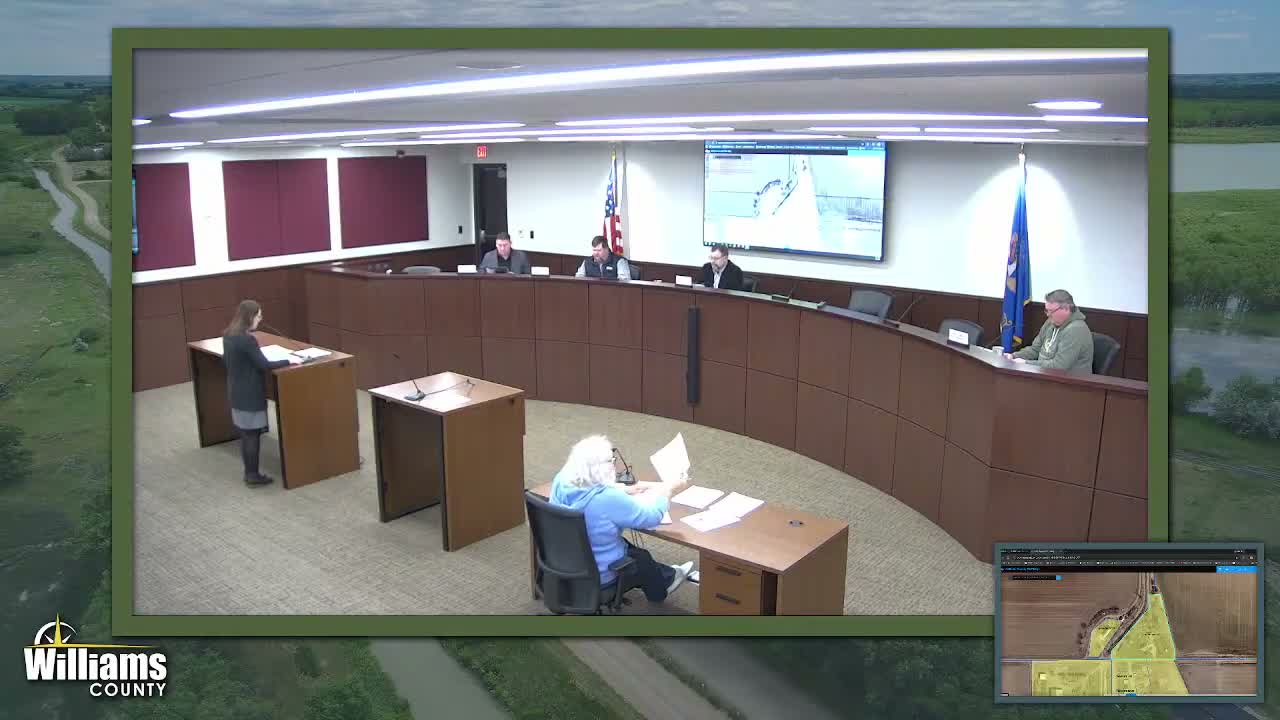
Summary
After extended public testimony, the Williams County Commission approved Apex Clean Energy’s Homestead Wind conditional-use permit and two variances — allowing up to 67 turbines within a larger 81-location application — and authorized related transmission and permitting conditions. Opponents raised wildlife, procedural and visual-impact concerns.
The Williams County Board of County Commissioners voted Monday to approve the Homestead Wind conditional-use permit and two associated variance requests filed by Apex Clean Energy, following more than two hours of applicant presentations and nearly three hours of public comment.
Apex senior development manager Matt Eberl told the commission the Homestead Wind project is an up-to-256.5 megawatt facility that has secured voluntary agreements with roughly 25,000 acres and 37 landowners. He said the application includes up to 81 proposed turbine locations as alternates but that no more than 67 turbines would be built. "We have secured nearly 25,000 acres that are necessary and needed to build the facilities themselves," Eberl said. He added the company has signed a generator interconnection agreement and expects to fund about $32 million in local transmission upgrades.
Bree Anderson, Apex’s senior director of permitting, outlined the company’s modeling and environmental review. She said the project meets both Williams County setback rules and North Dakota Public Service Commission sound and shadow-flicker standards, noting the company modeled conservative assumptions — including modeling all 81 turbine locations and adding a 2-decibel margin — to ensure compliance. "Even with these conservative assumptions, turbines are cited to meet the Public Service Commission’s regulations," Anderson said.
Opposition and support
Speakers were sharply divided. Opponents, represented by residents who said they delivered a 58-signature petition, questioned the completeness and public availability of wildlife and archaeological surveys and said publicly released meeting notes were redacted. Ryan Wade of Good Luck Township said some state-agency meeting notes initially were withheld and later supplied by Apex, and pressed for greater transparency. "Some of the archaeological and wildlife survey information was incomplete or redacted when the public tried to obtain it," Wade said.
Other residents, including multiple participating landowners, supported the project for the direct payments and tax revenues it would generate for schools, fire and ambulance districts and townships. Cal Storseth, who said he had leased land to the project, described long-term lease revenue as an important income stream for family farms. "They're going to pay 40 landowners over $60,000,000 over the next 30 years," Storseth said.
Technical and regulatory responses
Apex and its consultants answered questions on a range of technical issues. The company said turbines would comply with the PSC sound standard of 45 decibels within 100 feet of an occupied residence and that shadow flicker had been modeled to remain below county limits (the company cited a 30-hour-per-year guideline for participants). Environmental staff said they coordinated with the North Dakota Game and Fish Department and the U.S. Fish and Wildlife Service; company counsel said some data are redacted in public summaries at the agencies to protect sensitive resource locations, but that the full reports had been provided to county staff and were available to the commission.
On decommissioning, outside counsel explained PSC rules require financial security equal to 5% of construction costs prior to construction and an engineer-determined amount for final decommissioning security; the counsel said PSC practice does not generally credit salvage value in that calculation.
Board deliberations and outcome
Commissioners debated procedural options — including whether to table the item and hire an outside reviewer — and considered motions to deny and then to approve. The motion to table and seek a third-party review failed. After further discussion the board approved the Homestead Wind CUP and associated variance requests, with conditions aligned to planning staff recommendations and county legal review. The final roll call recorded three votes in favor and two opposed; the chair declared the motion carried.
What happens next
Approval by the county allows Apex to continue state permitting, including the Public Service Commission certificate of site compatibility and the required decommissioning plan and financial security. Apex said it will negotiate a road-use agreement and return for building permits and other county-level approvals before construction. The company estimated construction could begin in 2027 with operations by 2028, contingent on final state and county approvals.