Get Full Government Meeting Transcripts, Videos, & Alerts Forever!
Get email alerts on the Housing topic
No spam. Unsubscribe anytime.
Spokane resident urges county to adopt 0.1% sales tax to fund housing as federal cuts loom
Summary
At the Spokane County meeting on Jan. 6, public commenter Becky Dickerhoof warned that proposed federal changes to HUD and related programs could reduce services and urged commissioners to adopt the local '15 90' tax (RCW 82.14.530) to fund affordable housing; she said an estimated 20,000 units are needed to eliminate homelessness in Spokane.
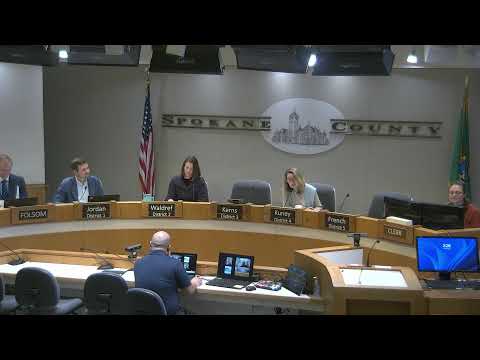
Becky Dickerhoof, identifying herself as from Spokane City, told the Spokane County Board of Commissioners on Jan. 6 that proposed federal changes to housing and assistance programs threaten supports for people experiencing homelessness and urged local action to replace funding.
"If you are homeless or experiencing housing insecurity, the changes being made to HUD funding has you very worried about your future," Dickerhoof said during the meeting's open public forum. She named programs she said would be affected, including Community Development Block Grants (CDBG), the HOME Investment Partnerships Program (HOME) and the Supplemental Nutrition Assistance Program (SNAP), and warned that reductions would leave families with fewer resources for repairs, counseling and basic needs.
Dickerhoof urged the commissioners to enact what she called the "15 90 tax," citing RCW 82.14.530 as the statutory vehicle that allows a county legislative authority to impose a sales-and-use tax of up to one‑tenth of 1 percent to fund housing. She told the board that under the statute at least 60% of the revenue must be used for construction of housing and the balance may fund operations and services. She also said the community faces a need for roughly 20,000 housing units to eliminate homelessness in Spokane.
Her remarks included an expression of hope that a recent federal judge's ruling blocking the specific HUD changes she referred to might preserve low‑income housing and food funding. Those policy claims were made as public comment and were attributed to the speaker; the board did not take action on the proposal during the meeting.
Dickerhoof concluded by asking the commissioners to consider the local tax authority to create more housing and related services for unsheltered residents.