Get Full Government Meeting Transcripts, Videos, & Alerts Forever!
Get email alerts on the Education Infrastructure topic
No spam. Unsubscribe anytime.
Washoe County School District outlines Facility Modernization Plan, says Ward 3 will get $250M+ in investments; community questions closure and notification
Summary
Washoe County School District trustees briefed the Ward 3 advisory board on the district’s Facility Modernization Plan (FMP), saying the district has invested more than $1.5 billion to date and plans more than a quarter-billion dollars in Ward 3 over five years. Community members asked about proposed repurposing/closures, notification, Spanish-language outreach, and zoning advisory processes.
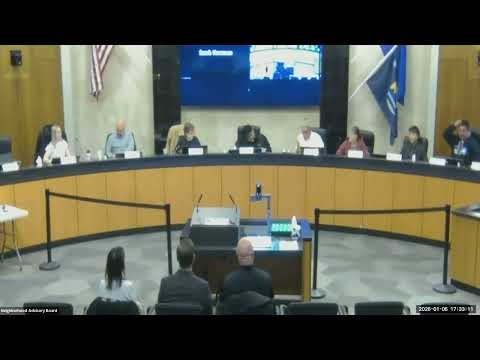
Washoe County School District leadership presented a detailed overview of the district’s Facility Modernization Plan (FMP) and its implications for Ward 3 at the Jan. 6 Neighborhood Advisory Board meeting.
Chief operating officer Adam Searcy and Board President Beth Smith summarized the program’s history — a 2016 voter-approved sales-tax measure (referred to as WC1) that the district used to build 10 new schools and complete five major additions since 2019 — and said the district has invested more than $1,500,000,000 into the program (SEG 1603-1660, SEG 1652). Searcy said the FMP’s three primary elements are modernization, reconstruction and repurposing, and stressed that individual projects require multiple rounds of community input, Capital Funding Protection Committee review and board approval (SEG 1788-1799, SEG 1690-1699).
Why it matters: the district said it will pursue reconstruction at Vaughn Middle School and Echo Loder Elementary and pursue modernization work across several campuses in Ward 3, and that this phase of work seeks to concentrate resources to deliver more equitable facilities. The district said it plans to invest more than a quarter of a billion dollars in Ward 3 over the next five years (SEG 1963-1966).
Community concerns: many attendees asked about proposed closures and repurposing, especially for Veterans Elementary and other longtime community schools. Residents and board members pressed the district on how families will be notified and on language access for Spanish-speaking residents; trustees said Zoning Advisory Committee meetings, translated materials and direct outreach (calls/emails to affected families) will be used and that multiple public meetings are held in affected neighborhoods (SEG 2198-2206, SEG 2203-2211, SEG 2444-2470). Searcy emphasized that decisions about closures require legal notice and a public board vote, and that repurposing proposals would be made in partnership with affected communities (SEG 1879-1886, SEG 2539-2551).
Fiscal and policy pushback: a public commenter (Beth Dorey) criticized the WC1 sales tax as regressive, noted the district’s $1.5 billion in expenditures and asked why enrollment is declining despite city growth; she urged sunset of the tax measure and called for studies on why families leave the district (SEG 2774-2850).
Process and next steps: staff said zoning advisory committee meetings are scheduled when boundaries are affected (monthly), the Capital Funding Protection Committee reviews expenditure proposals bi-monthly, and that specific projects (such as the Pine Campus elementary, Echo Loder reconstruction and Vaughn work) will undergo further community-level meetings and formal zoning or board processes before any final decision (SEG 2396-2402, SEG 2408-2411, SEG 2011-2012).