
Martin County commissioners approve brownfield designation for Hobe Sound property over dissent
Get AI-powered insights, summaries, and transcripts
Subscribe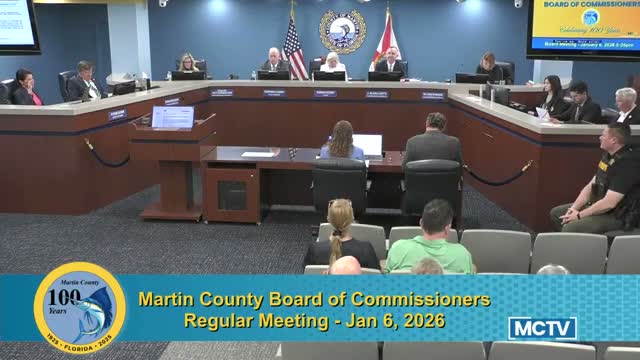
Summary
After testimony from county staff, an economics consultant and the property owner, the Martin County Board of County Commissioners voted 4–1 to designate 9450 Southeast Gomez Avenue in Hobe Sound as a brownfield area, allowing a state-supervised cleanup and potential redevelopment of about 19.44 acres for 38 single-family homes.
Martin County commissioners voted 4–1 to designate a 19.44-acre parcel at 9450 Southeast Gomez Avenue in Hobe Sound as a brownfield area, clearing the way for a state-supervised cleanup and future residential redevelopment.
At a quasi-judicial second public hearing, senior planner Jenna Nabi told the board the designation process under Section 376 of the Florida statutes requires the applicant to meet five criteria. Staff recommended adoption of a resolution designating the property as a brownfield after reviewing environmental reports, a site plan and supplemental financial documentation. "Staff recommends that the board receive and file the agenda item and its attachments and find this request meets the criteria," Nabi said during her presentation.
Applicant counsel Michael Schnappsteler and a hired economist, Anthony (Tony) Donardo of Fishkind Consulting, presented evidence aimed at meeting the statutory tests. Donardo testified the project would generate about 6.8 community-related full-time-equivalent jobs (security, landscape, fitness/recreation staff) and about 15.2 household-related FTEs (home services such as cleaning and maintenance), totaling roughly 22 FTEs. "We divided the types of jobs into two categories," Donardo said, explaining the methodology used to estimate employment effects.
Property owner Richard Wasserstein testified he and his family have contributed personal funds toward the project, that the applicant has a $35,000,000 loan commitment and additional partner funds documented in the record, and that they intend to clean up arsenic contamination and redevelop the parcel. "I've spent close to $100,000 testing and trying to designate the area that has the contamination," Wasserstein said. He added that lenders including New Wave Residential and Ocean Bank have expressed willingness to finance the project.
Several neighbors and residents urged caution. Mary Gavin, who said she conducted independent sampling of a county swale adjacent to the site, reported a DDT result and asked the board to hold action pending additional off-site testing. "I think it should be put on hold," Gavin said, citing concerns about testing outside the property and a possible LoopNet listing she found contradicting prior statements about the site’s sale status. Another resident asked county staff to consider testing for homes in the Petway neighborhood east of the railroad that lack potable public water.
Applicant counsel responded that the Florida Department of Environmental Protection (DEP) is the regulatory authority that reviews the full assessment history, directs where to sample on- and off-site as needed, and enforces cleanup obligations through a brownfield cleanup agreement. Schnappsteler told the board that tax credits and other program benefits are subject to strict DEP review, CPA verification of expenditures and that the DEP will deny applications that do not comply with statutes and rules.
Commissioners debated whether the record contained "competent substantial evidence" to satisfy the five statutory criteria, focusing most heavily on job-creation estimates and financial assurance. Growth management director Paul Schilling said the county routinely relies on professional reports and testimony in quasi-judicial matters and that staff found the submitted materials sufficient. Commissioner Campe argued that designation would enable cleanup and protect nearby residents, while Commissioner Vargas said cleanup could proceed without designation and raised skepticism about some of the job and financing assumptions.
Commissioner Campe moved to accept staff's recommendation; the motion passed 4–1, with Commissioner Vargas dissenting. The board did not specify conditions beyond the statutory record; Schnappsteler said that if the designation is approved the owner plans to execute a brownfield cleanup agreement with the DEP and follow the state administrative framework for remediation and advisory-committee reporting.
The board’s action permits DEP oversight and the brownfields administrative process to proceed; it does not itself approve construction or site plans for the proposed 38 homes. Subsequent permits, cleanup plans and any tax-credit applications would be subject to separate state and local review.