Get Full Government Meeting Transcripts, Videos, & Alerts Forever!
Get email alerts on the Environment Plastic Policy topic
No spam. Unsubscribe anytime.
Hawaii County Council approves amended ban on single‑use plastic foodware, broadens accepted compostable certifications
Summary
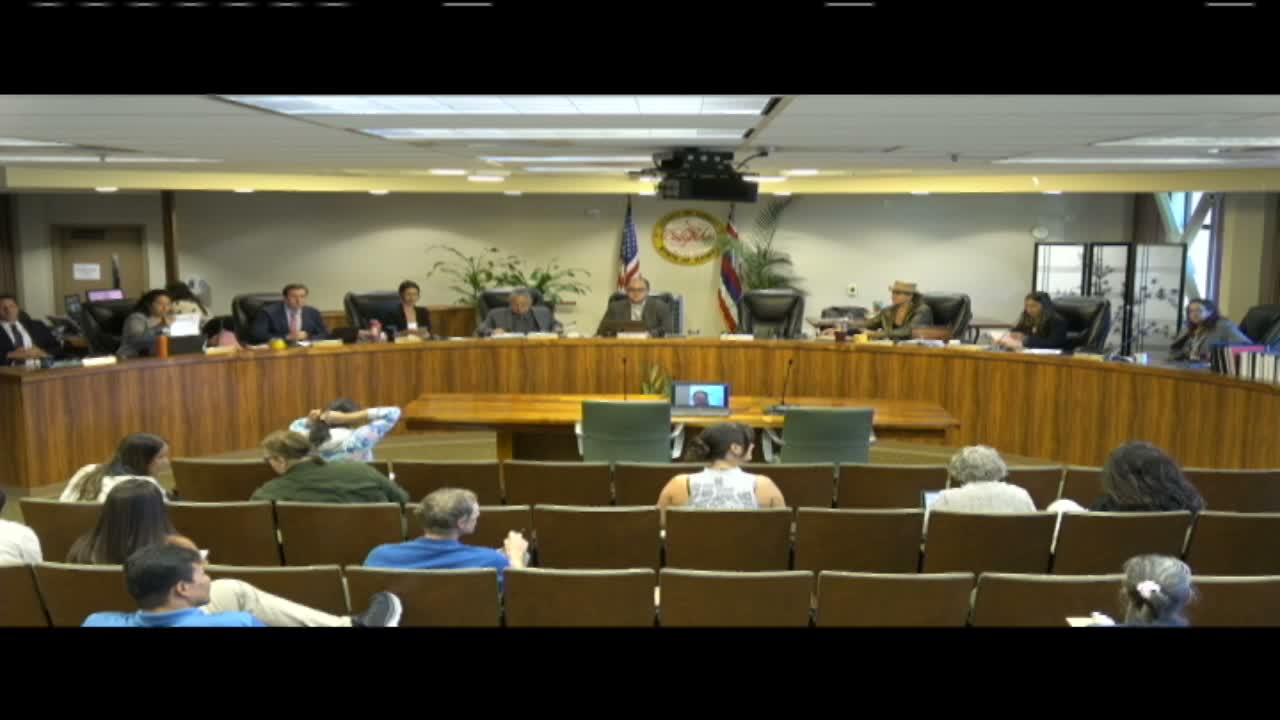
After hours of public testimony and agency questioning, the Hawaii County Council passed Bill 83 (second and final reading) on Dec. 3, 2025, adopting a law to phase out certain single‑use plastic foodware while amending its certification language to accept any third‑party certifier that verifies ASTM compostability standards.
The Hawaii County Council approved Bill 83 on second and final reading on Dec. 3, 2025, voting 8–0 with one member excused after extensive public testimony and technical questioning of county staff.
Supporters, including students, environmental nonprofits and some agriculture and waste‑diversion operators, urged the council to act on plastic pollution, pointing to microplastics, stressed landfill capacity and local composting pilot projects. "Plastic is this generation's downfall, and I don't want it to be the next," said Kalia Edmonds, a seventh‑grade student who testified in favor of the measure. Recycle Hawaii's executive director, Christine Kubat, told the council that community groups and businesses are prepared to help with implementation and that other counties have moved ahead without catastrophic impacts.
Opponents — including the mayor and a range of business and waste‑management professionals — argued the county lacks industrial‑scale composting capacity and that switching to certified compostables could raise costs for small restaurants and vendors. Jason Higa, CEO of Zippy's Restaurants, testified that "Hawaii County does not have a composting facility that can process the containers required under this bill" and urged delaying the ban until processing systems and economic impacts are addressed. Multiple waste experts warned about composable materials (notably PLA) requiring specific processing conditions to avoid fragmentation or unintended environmental harms.
The council responded to several of those concerns by adopting an amendment to the bill that removes a narrow list of accepted certifiers and instead requires third‑party certification demonstrating compliance with recognized ASTM standards (including ASTM D6400, D6868 and D8410 or equivalent). Councilmember James Eustace, who moved the amendment, said the change aims to "allow all certifying bodies and associated products to meet the requirements of the bill, which will promote equal opportunities for all businesses in the County of Hawaii." Council discussion also highlighted decentralized "in‑vessel" composting and reuse pilots as options to address infrastructure constraints.
DEM (the Department of Environmental Management) provided a memo urging caution and recommending a small‑business impact review and dedicated outreach. DEM staff told the council they had limited time to prepare their analysis and offered to convene stakeholder advisory groups and follow‑up studies to clarify costs and permitting needs. Deputy corporation counsel referenced HRS 201M as the relevant state provision for a small‑business impact study if the county pursues that review.
The passage completes the council's second and final reading, with the council recording ayes from Galemba, Huestes, Kaguada, Kurkowitz, Campbell, Vice Chair Onishi (with reservation), Villegas and Chair Inaba. The mayor had asked the council to reject the bill as written.
Next steps: the ordinance as amended will proceed to whatever remaining administrative steps are required for implementation, including rulemaking and the outreach and readiness work DEM described. The council also included implementation exemptions and transition timelines in the ordinance text; details and enforcement timelines will be set by the county during rule development.