EPA, county and state agencies update Monterey supervisors on Moss Landing ML‑300 battery fire cleanup
Loading...
Summary
County emergency management and state/federal partners told the board that 12,000 of 35,772 batteries have been de‑energized and removed, phase‑1 stabilization is complete, sampling results to date show no clear human‑health risks at the sampled locations, and phase‑2 demolition is planned for mid‑2026.
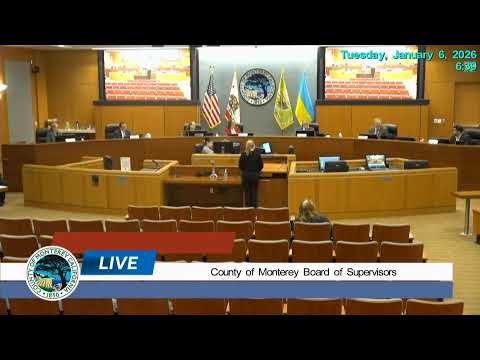
Monterey County Department of Emergency Management and partner agencies briefed the Board of Supervisors on Jan. 6 about ongoing recovery and cleanup work at the Moss Landing ML‑300 battery energy storage facility, site of a Jan. 2025 structure fire and hazardous materials incident.
Kelsey Scanlon, the county's emergency management director, said removal operations continue systematically: roughly 12,000 battery modules have been de‑energized and shipped for recycling out of an estimated total of 35,772. De‑energization runs around the clock excluding Sundays; staff reported no flare‑ups to date. Each truckload carries about 192 modules on 24 pallets and the current average is five to six truckloads per week.
Staff said the site has a closed‑loop stormwater system and that EPA has protocols and testing in place to ensure water captured on‑site is analyzed for contaminants before off‑site disposal per California State Water Board requirements. Because batteries can reignite in wet conditions, workers are protecting staged batteries under tents during rainy weather. The U.S. EPA and the U.S. Coast Guard Pacific Strike Team are providing federal oversight; the EPA continues to manage air and water monitoring.
Environmental sampling (phase 2) conducted in September (sediment, surface water and pore water) was analyzed by Terraphase Engineering and reviewed by state agencies. The phase‑2 report concluded sampled areas were protective of human health and ecological receptors and did not indicate aerial deposition impacts from the ML‑300 fire. Where certain metals exceeded ecological screening values, agency reviewers said those concentrations were consistent with natural background or marsh geochemistry. DTSC toxicologists reviewed the report and did not request revisions. The Environmental Health Bureau said the phase‑2 results and DTSC comments would be posted on the county's readymontereycounty.org site.
The county noted that further work — removal of intact Type‑1/2 batteries and phase‑2 demolition down to the concrete foundation and characterization of burned debris — is planned for 2026. Sampling of burned debris will be completed and results published. The EPA has posted updated FAQ fact sheets on water management, truck routes and community safety protocols.
Public commenters at the meeting raised concerns about sampling methods, independent verification, potential radioactivity from legacy PG&E operations and monitoring data integrity; some alleged misconduct by federal agencies or contractors. County staff acknowledged community concerns, said the EPA and state partners are overseeing sampling and interpretation, and offered to follow up with individual residents to provide details.
County staff also invited state agency toxicologists and risk assessors to appear at the board's March 17 meeting to answer community questions about the preliminary environmental assessment (PEA) and community sampling.