
Mass. high court weighs whether unprepared transfer counsel voided Donovan case
Get AI-powered insights, summaries, and transcripts
Subscribe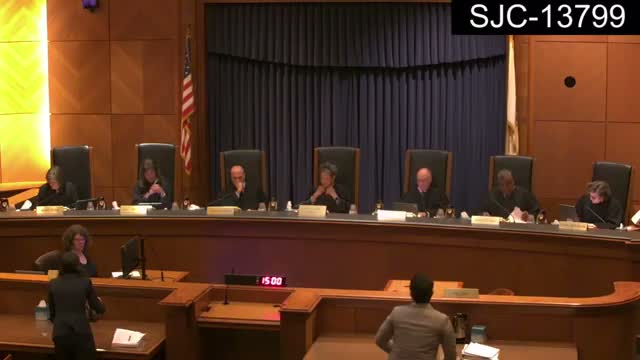
Summary
At oral argument the Supreme Judicial Court examined whether defense counsel’s limited presentation at a 2017 juvenile transfer hearing amounted to ineffective assistance and, if so, whether the superior-court conviction must be vacated or the matter remanded for further juvenile-court findings.
BOSTON — The Massachusetts Supreme Judicial Court on Thursday heard competing arguments over whether the defense lawyer’s limited presentation at a 2017 juvenile transfer hearing deprived Brian Donovan of effective assistance and, if a deficiency is found, what remedy would follow.
Attorney Ruth O'Meara Costello, representing Donovan, told the court that transfer counsel ‘‘made exactly two points’’ at the hearing — that Donovan had no criminal record and that a long time had passed since the allegations — and pressed that ‘‘the judge should have bailed counsel out’’ by granting a continuance to allow a fuller presentation. Costello said the juvenile judge omitted social‑history evidence that might have influenced the discretionary transfer decision and argued the omission contributed to Donovan’s later conviction and state prison sentence.
‘‘He’s the one who has now served a state prison sentence,’’ Costello told the justices, urging that the court find counsel’s performance deficient and prejudicial under the applicable standard so the superior‑court verdict cannot stand.
Assistant District Attorney Megan Monahan, arguing for the Commonwealth, countered that Donovan’s motion for a new trial ‘‘did not raise a substantial issue’’ and that the transfer judge, an experienced juvenile jurist, heard the victim’s testimony and — in the Commonwealth’s view — permissibly inferred maturity and social‑history considerations even though those details were not explicitly placed on the record.
Monahan also pointed the court to Dr. Frank Di Cataldo’s evaluation, which she said recommends Donovan is at low risk for a future violent sexual offense under one instrument (RSVP‑2) and noted the report did not assess static‑99R. She argued the report does not undercut the juvenile judge’s public‑safety concerns and urged the justices to affirm the conviction.
The justices pressed both sides on several practical and legal questions. They asked whether an appeal of a transfer ruling is available before a superior‑court verdict (the defense acknowledged that interlocutory appeal is not available), whether post‑2017 evidence should be admitted on remand, and who should decide prejudice — the juvenile court or the superior court. Costello said if counsel’s deficiency and resulting prejudice are found, the superior‑court conviction must be vacated because the superior court lacked valid jurisdiction; Monahan described a procedural path in which a motion for a new trial in Norfolk Superior Court could be remanded for an evidentiary hearing in juvenile court before the original transfer judge and, depending on findings, a subsequent motion to vacate might follow.
Both sides acknowledged gaps in the record: Costello said some potentially exculpatory evidence (affidavits from a neighbor and an employer, and a psychological evaluation) exists now but arose after 2017; Monahan argued the Commonwealth would ‘‘strongly object’’ to admitting post‑transfer evidence at an evidentiary hearing focused on what counsel could have obtained in 2017.
The justices also questioned whether transfer counsel’s limited presentation might have been tactical — choosing to focus on probable‑cause issues first — but Costello rejected that characterization and relied on counsel’s affidavit and an affidavit from an experienced practitioner to explain why bifurcated practice occurs.
The court did not announce a decision at argument. The justices extensively questioned the parties about remedies and procedural sequencing; any opinion will determine whether the court resolves the transfer‑counsel ineffective‑assistance question first or also reaches alleged trial errors previously briefed by Donovan’s counsel.
The case centers on the scope of a Section 72(a) transfer hearing and the standard for establishing ineffective assistance in that context; parties cited Commonwealth v. Kavanaugh and other authorities during argument. Monahan said precedent and the transfer judge’s findings supported transfer; Costello urged the court to order further proceedings to test whether counsel’s shortcomings prejudiced Donovan’s rights.
If the justices direct a remand, they will need to decide whether the juvenile court’s inquiry on remand is limited to evidence counsel could have obtained before 2017 or whether limited post‑2017 evidence (such as affidavits and evaluations) may be considered in evaluating prejudice and remedy. The court’s ruling will affect whether Donovan’s conviction stands, is retried, or is vacated for lack of jurisdiction.
No decision was issued from the bench at the close of argument.