
Supreme Judicial Court hears challenge to detaining defendants to secure inpatient competency evaluations
Get AI-powered insights, summaries, and transcripts
Subscribe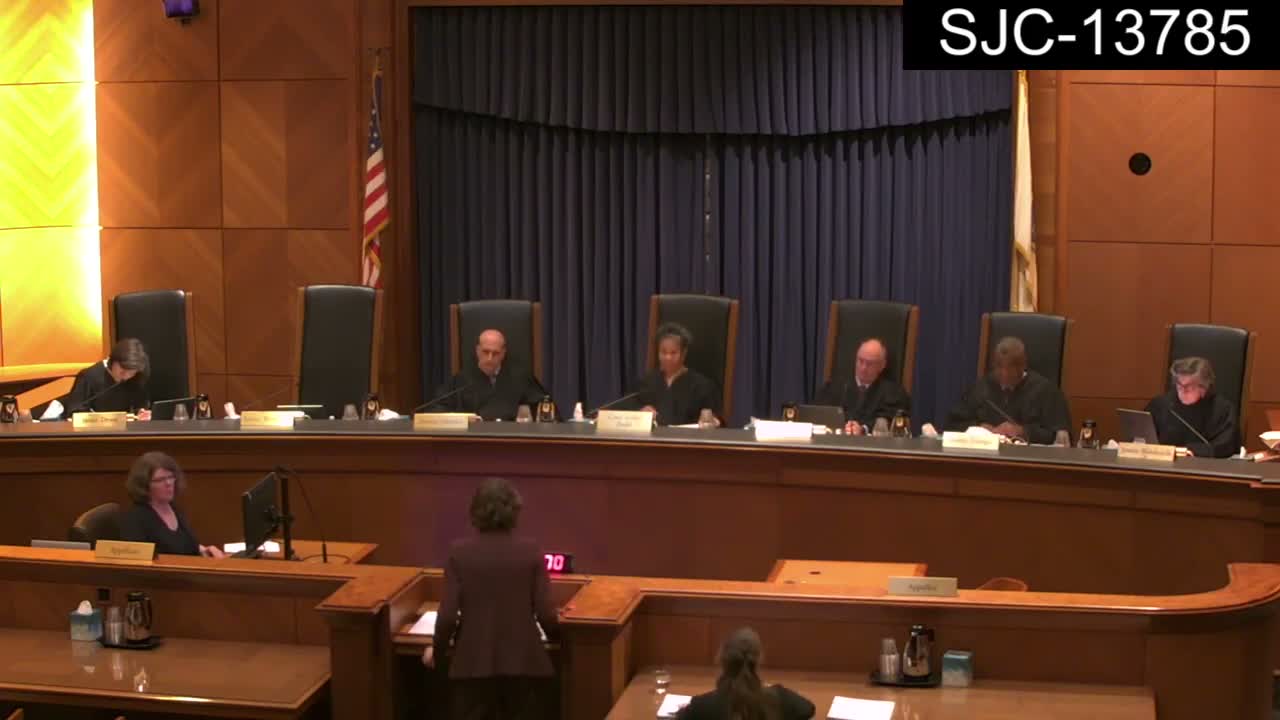
Summary
In a single‑justice oral argument, counsel for SW urged the Supreme Judicial Court to rule that courts lack authority to detain defendants without bail solely to obtain inpatient competency evaluations and to adopt expedited appellate procedures; the Commonwealth urged local forums may provide faster review.
The Supreme Judicial Court heard argument over whether courts may detain criminal defendants without bail for the sole purpose of securing inpatient competency evaluations, and related questions about when a court may order a Section 15b hospital evaluation and which forum should hear appeals.
Attorney Mikaela Martin Stroud, representing the defendant identified in the record as SW, told the court that the Commonwealth does not point to statutory authority allowing courts to hold people without bail merely to facilitate competency evaluations and urged the court to exercise its superintendent authority to resolve what she called a recurring practice across the Commonwealth. "We are asking the court to exercise its discretion to address this issue under its superintendent's authority," Stroud said.
Stroud framed three issues for the court: (1) whether defendants awaiting competency evaluations may be detained without bail, (2) whether a Section 15b inpatient evaluation may be ordered after a clinician's in‑court Section 15a opinion is recorded, and (3) whether symptoms of mental illness and a lack of voluntary treatment in the community can, by themselves, justify inpatient hospitalization under Section 15b.
On the detention question, counsel and the bench agreed the Commonwealth acknowledged there is no clear statutory authority authorizing detention without bail solely to secure an evaluation; Stroud cited at least four single‑justice opinions since October 2024 raising the same concern and said the SJC should provide uniform direction rather than leaving the issue to piecemeal single‑justice decisions.
The second issue focused on whether a judge may order a 15b after a 15a clinician has already expressed a clinical opinion that the defendant lacks competency. Stroud emphasized the legal distinction between a clinician's clinical opinion and the court's legal determination of competency at a Section 15d hearing, arguing that a 15b should be ordered only where further inpatient evaluation is necessary and the least‑restrictive‑alternative test is satisfied. "I further credit Doctor Reese's findings that SW is not fully aware of the charges or the consequences that she is currently facing," Stroud told the court, noting the judge in the lower court expressly credited the clinician's testimony but did not itself find legal incompetency.
The third issue probed whether mental‑illness symptoms and the defendant's failure to be voluntarily engaged in outpatient treatment can serve as a lawful basis for inpatient evaluation. Stroud said mental illness may be a factor but should not be dispositive; she pointed out that SW appeared on personal recognizance for arraignment, which suggests the ability to comply with court orders in this case.
Counsel also pressed procedural remedies. Stroud argued that existing appellate routes are often too slow for short inpatient commitments: she described how the appellate division's procedures can delay transfer and noted that under current practice an appeal may not reach the appellate division within 60 days—longer than short involuntary commitments—and urged the court to adopt expedited rules similar to those used for Section 35 matters. She proposed a target of seven days for expedited appellate handling in these cases and waivers of transcript preparation when appropriate.
Jocelyn McGrath, for the Commonwealth, responded that the orders at issue are ambiguous and that in many instances the superior court can provide swifter review of purported bail revocations; she acknowledged the recurring nature of the problem but argued that separate local remedies may be appropriate and more practical in many cases.
Justices and counsel debated the line between securing treatment and securing a competency assessment, and whether a brief in‑court 15a can ever supply sufficient information to resolve whether a defendant is incompetent or can be brought to competency. The bench repeatedly noted the practical recurrence of the practice at the trial level and asked whether a definitive ruling from the SJC is needed to stop it.
The court heard argument; no decision was announced from the bench. The matter remains under advisement pending any written order or further action by the court.